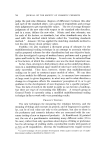
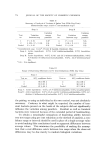
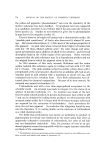
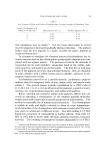
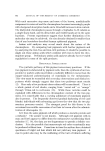
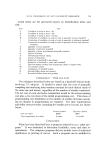
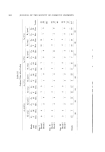
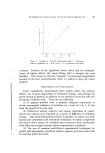
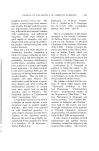
774 JOURNAL OF THE SOCIETY OF COSMETIC CHEMISTS Table II Summary of Analysis of Variance of Quinn Test (Fifth Day Data) (Bacteriostatic soaps A & B rs. non-medicated soap a) Soap A Soap B Variation Variation Test Variation among Test Variation among no. between soap panelists no. between soap panelists 1 P 0.01 N.S. b 3 P 0.01 N.S. 2 0.025 P 0.05 N.S. 4 0.05 P 0.1 N.S. Pooled P 0.01 N.S. Pooled P 0.01 N.S. Nonmedicated soap: Ivory ©, Procter & Gamble, Cincinnati, Ohio. Soap A: Active ingredients: 0.75% 3,4,4•-trichlorocarbanilide, 0.75% hexachloro- phene. Soap B: Active ingredients: 0.67% 3,5-di- and 3,4',5-tribromosalicylanilides, 0.67% 4,4•-dichloro-3-(trifluoromethyl)carbanilide, 0.67% 3,4,4•-trichlorocarbani - lide. N.S.: Not significant. Table III Range of Degerming Efficiencies in Per Cent Reductions (Fifth Day Data) Soap A Soap B Test no. 95% confidence limits Test no. 95% confidence limits 1 88.5-98.5 3 84.5-99.4 2 83.0-91.5 4 86.5-97.5 Pooled 87.4-96.2 Pooled 87.7-98.9 Soap A' Active ingredients: 0.75% 3,4,4•-trichlorocarbanilide, 0.75% hexachlorophene. Soap B: Active ingredients: 0.67% 3,5-di- and 3,4•,5-tribromosalicylanilides, 0.67% 4,4 •- dichloro-3-(trifiuoromethyl)carbanilide, 0.67• 3,4,4•-trichlorocarbanilide. the pairing, or using an individual as his own control, was not absolutely necessary. Contrary to what might be expected, the number of tran- sient bacteria present on the hands of the subjects did not significantly influence the variation among panelists. Resident as well as transient bacteria were removed because of the extended period of handwashing. To obtain a meaningful comparison of degerming ability between two test soaps using per cent reduction as the method of analysis, a con- fidence range or interval should be used in place of a single average value to avoid making false conclusions based on apparent differences between average values. This minimizes the possibility of making the assump- tion that a real difference exists between two soaps when the observed differences may be due merely to random biological variations.

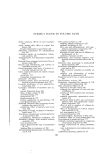
HAND DEGERMING EVALUATION 775 Results of the tests are summarized in Table III using per cent re- duction as the method of analysis. Only the 95% confidence limits are shown so as to emphasize the importance of using a range in the inter- p retation of per cent reduction calculations. (Received April 12, 1967) REFERENCES (1) Updegraff, D. M., A cultural method of quantitatively studying the microorganisms in the skin, J. Invest. Dermatol., 43, 129-137 (August 1964). (2) Ulrich, J. A., Technics of skin sampling for microbial contaminants, tJosp. J•opics, 43, 121- 123 (March 1965). (3) Pachtman, E. A., Vieher, E. E., and Brunner, M. J., The bacteriologic flora in seborrheic dermatitis, J. Invest. Dermatol., 22,389-396 (May 1954). (4) Price, P. B., The bacteriology of normal skin a new quantitative test applied to a study of the bacterial flora and the disinfectant action of mechanical cleansing, J. Infect. Dis- eases, 63, No. 3, 301-318 (1938). (5) Cade, A. R., Antiseptic soaps: a simplified in vivo method for determining their degerm- ing efficiency, Soap Sanit. Chemicals, 26, 35-38 and 73 (July 1950). (6) Roman, D. P., Barnett, E. H., and Balske, R. J., Cutaneous antiseptic activity of 3,4,4 •- trichlorocarbanilide, ?roc. Sci. Sect., Toilet Goods •4ssoc., 1%. 28, 12-13 (December 1957). (7) Kooistra, J. A., Barman, E. A., and Carter, R. O., Use of human subjects for praduct evaluation: an evaluation of antibacterial soap bars, J. Soc. Cosmetic Chemists, 17, 343- 353 (May 1966). (8) Quinn, H., Voss, J. G., and Whitehouse, H. S., A method for the in vivo evaluation of skin sanitizing soaps, Jppl. •Iicrobiol., 2,202--204 (July 1954).
Purchased for the exclusive use of nofirst nolast (unknown)
From: SCC Media Library & Resource Center (library.scconline.org)