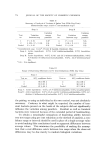
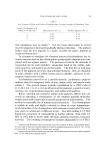
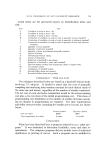
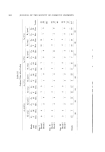
THE COLOR OF RED IIAIR 781 'Fable I Iron Content of Hair and Feather Pigments after Varying Lengths of Extraction Time Length of extraction with boiling 0.1N HC1 (hr) Hair pigment (Fe r)•) Feather pigment (Fe %) 1 O. 38 O. 51 2 O. 24 O. 17 3 0.15 0.15 this calculation may be faulty.* Yet the basic observation is correct that the pigment is destroyed gradually during extraction. The authors believe that the iron pigment is a major, possibly the major, pigment of bright red human hair. In attempts to elucidate the chemical nature of trichosiderin, the re- search concentrated on the chromophore group which contains iron com- plexed with an organic moiety. The presence of iron in the molecule is responsible for its acid solubility, absorption band in the visible, indi- cator property, and neutral iso-electric point. The iron-free or iron-poor parts of the pigment have few characteristic features they are insoluble in acids, dissolve with a yellow-brown color in alkalies, and have no ab- sorption band in the visible. Trichosiderin proved to be a metallo-protein preliminary analyses indicate that it is composed soldy of iron, amino acids, and maybe some amines. } The protein nature is firmly established by a CHN ratio of 47.2-49.2, 6.8-7.3, 15.4-16.3 in all forms of the pigment, a positive Lowry reaction (14), typical infrared spectra, and amino acid analyses. Before carrying out extensive amino acid analyses, efforts were di- rected at obtaining a chromophore of the smallest possible molecular weight which still retains all the specific properties of trichosiderin. The method is essentially one of repeated acid extraction. The chromophore is soluble in acids and highly resistant to them at room temperature. Acid extraction of the chromophore with successive removal of the iron- poor parts is carried out at different levels: first with boiling 0.1N HC1 during the extraction of trichosiderin or feather siderin then with HC1 or 10% KSCN which splits off large amounts of brown, iron-poor material. The resulting chromophore becomes dialyzable in 0.iN HC1. * Dutcher and Rothman's data are based on an iron content of 10%, an unrealistic figure. At best, such a high iron content could be found in purified preparations only (5, 15) in the present work it was impossible to obtain such samples. } Improved analytical methods may account for the discrepancies between earlier reported data (5, 15) :tnd those reported herein.

782 JOURNAL OF THE SOCIETY OF COSMETIC CHEMISTS With each successive step more and more of the brown, nondialyzable component is removed and the ½hromophore becomes increasingly purple with sharpened absorption bands and a threefold increase in iron content. The dialyzable chromophore passes through a Sephadex G-50 column as a single sharp band, and its ultraviolet and visible bands are in the same fractions. Present experiments suggest that further diminution of its molecular size may be achieved the size already obtained is smaller than that of any heretofore described human epidermal pigment. Amino acid analyses may reveal much about the nature of the chromophore. By comparing hair pigments with feather pigments and by analyzing the iron-free and iron-rich portions, it should be possible to single out those amino acids which combine with iron to form the chro- mophore group. Preliminary amino acid analyses already have revealed regularities in some of the split products. BIOLOGICAL IMPLICATIONS The synthetic pathway of this pigment raises many questions. If the iron pigment is elaborated by pigment cells, then the synthesis of an iron- protein by nucleic acids must follow a radically different course than the copper-catalyzed polymerization of eumelanin in the melanosomes. This view must be reconciled with everyday observations and clinical ex- perience which strongly suggest that these two pathways must coexist (2). Here only a few pertinent observations will be mentioned. There is a whole gamut of red shades, ranging from "carrot-red" or "orange" through Titian-red to red-brown (16). While these varieties could be explained with differences in the chromophore content of the iron pig- ment, it is conceivable that a varying admixture of eumelanin pigment also is present. The frequently observed gradual darkening of red (and blonde) individuals with advancing age favors the view that the two pig- mentary processes coexist. The strongest proof for this theory is the occasional irreversible conversion of red hair to brown after the adminis- tration of chloroquine (2). Is it then the same pigment cell which produces a metallo-protein and a melanin ? The answer is not known. Although red pigment cells in man and fowl appear to differ from the melanocytes synthesizing black melanins (17, 18), the data are too fragmentary to permit a definite con- clusion. It is also possible that macroscopic red color occasionally may be produced without iron. From time to time the authors have obtained specimens of bright red hair which did not yield any iron pigment. A case in point also may be the reddening of the hair of infants suffering
Purchased for the exclusive use of nofirst nolast (unknown)
From: SCC Media Library & Resource Center (library.scconline.org)