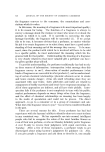
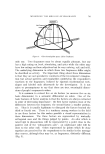
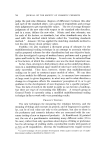
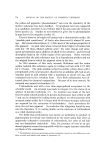
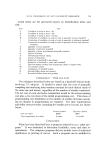
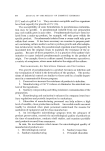
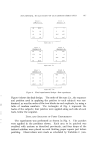
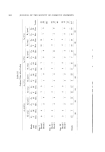
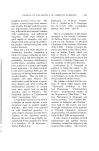
758 JOURNAL OF THE SOCIETY OF COSMETIC CHEMISTS A B C D E F G H I J Figure 1. Shapes of different areas (after Poffenberger) seven people were asked to rank the shapes their scores ranged from- 0.03 to +0.67, with an average score of +0.36. The interesting point is that when the judgments of these seven people were combined by addition, a ranking was obtained which scored +0.79, which is not only very much better than the average score of the respondents but is even distinctly better than the score of the best judge. When a ranking was obtained by combining the judgment of 20 individuals it scored -+-0.92, which is remarkably close to perfect. There was nothing unique about this experiment and about the results obtained. It has been repeated many times and you can repeat it at home, if you wish. You always find that the judgment of the group will be closer to the truth than that of the individual judges. The reason is that the mistakes of different judges tend to go in different directions. Among our seven judges there may have been three who underestimated the size of shape A, two who over- estimated it, and two who judged it correctly. When all the answers were combined, the negative and the positive errors largely canceled one another, so that the group answer was close to the truth. In ex- periments where you can't establish objectively how correct an answer is, you will find that the average judgments of larger groups are generally in better agreement with one another than the opinions of individuals. This is the reason why Paukner worked with 287 respondents. Another important feature of his experiment was that he did not allow his respondents to choose freely the words with which to describe the odors. If 287 people start associating freely with drugstores, grand- mother's gardens, things they eat, etc., it becomes impossible to combine their votes. He used a questionnaire in which the respondents were given words such as delicate, bitter, cold the instructions were to indicate on a clearly defined scale (0 = not at all appropriate, 4 = completely appropriate) the extent to which each word fits each odor.* With such * In similar experiments, many investigators prefer to use word pairs (delicate-rough, cold- warm) rather than single words each procedure has certain advantages.

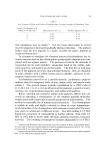
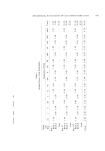
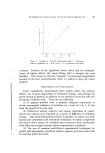
MEASURING THE MEANING OF FRAGRANCE 759 a highly structured questionnaire it becomes easy to arrive at a group judgment simply by adding individual votes. The technique of providing the respondent with words rather than letting him choose his own carries with it the danger of losing infor- mation a respondent will not be able to express the meaning an odor has for him if you don't provide him with the words with which to ex- press it. It is, therefore, important to use a well-chosen list of words and to make it long enough to include all aspects of odors that might be relevant. Paukner worked with a list of 66 adjectives. Actually, an extensive list may make the respondent more articulate than a free "open end" questionnaire by reminding him of ways to describe an odor which are meaningful to him but which he would not have thought of had he been left to his own devices however, we have to admit that there is a danger of "leading the witness" in this procedure. There is yet another advantage inherent in long lists: if they contain words that are either similar or nearly opposite in meaning, the results can be checked for consistency. An odor for which the word strong is rated as highly appropriate should probably have low ratings for delicate and mild. If it doesn't, it may be worth checking whether the respondents have understood the instructions and whether no mistakes were made in the tabulating or processing of the data. Often, where a single piece of information is not meaningful or statistically significant, a pattern of responses such as may be obtained in a longer questionnaire can convey valuable information. Naturally, there are practical limits to the length of a list of words: the longer it is, the more time-consuming and costly the interview and subsequent data processing and interpretation become. After having used his questionnaire in several large-scale tests the experimenter learns which adjectives are the most important and relevant for his particular kind of problems and which ones he can omit without losing much information. Using his lengthy questionnaire, asking 287 respondents to describe six odors and calculating the averages of their responses, what did Paukner achieve? He obtained profiles of odorants in terms of adjectives which give the perfumer, for the first time, a reliable, direct indication how these odorants strike his public, what kind of meaning they convey to nonperfumers (Fig. 2). This is certainly important, but it is only a first step. A very natural next step is to apply the same technique of questioning to complete perfume com- pounds rather than single ingredients. Thus Paukner (6) took a simple lavender composition and proceeded to add increasing amounts of an ambermuskcivet complex to it. According to the perfumer (2) this
Purchased for the exclusive use of nofirst nolast (unknown)
From: SCC Media Library & Resource Center (library.scconline.org)