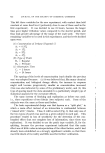
816 JOURNAL OF THE SOCIETY OF COSMETIC CHEMISTS design was to be repeated (replicated) three times, with two blocks or subjects in each replicate, confounding the four-factor interaction between each pair of blocks. The levels of the four variables were: A (Concentration of Irritant) A• = 1% Duponol C A•. = 4% Duponol C B (Type of Patch) B• = Regular patch (ef. Fig. 2) B•. = "Pressure" patch (cf. Fig. 3) C (Patch Contact Time) C• = 6 hours C•. = 24 hours D (Observation Time) D• = 2 hours after removing patch Ds = 18 hours after removing patch The factorial combination of the above resulted in 16 "runs" to be repeated in each of the three replicates. Each replicate consisted of two "blocks" or subjects, with eight runs applied to each. The quad- ruple interaction, ABCD, was confounded between each pair of blocks i.e., its effect, which was assumed a priori to be of no intrinsic interest, was "mixed" with that of the subjects. In the diagram which follows, standard two-level factorial notation is used. Thus, one of the sixteen runs was A•B•C•D• (1% Duponol, regular patch, 6 hours contact time and 2 hours' observation time). Another, for example, was A•.B2CiD• (4% Duponol, pressure patch, 6 hours, 2 hours). These two runs are designated in standard notation as run (1) and run ab, respectively. This notation includes the appro- priate lower case letter if the factor referred to is used at the high level, and omits this letter if the factor is used at its low level. Thus, the 16 runs in each replicate were: 1 (A•B•C•D•) a (A2B 1CiD,) b (A1B2C,D•) ab (A•B•C, D1) c (A•B•C•.D1) ac (A2BiC=D•) bc (A•B2C=D•) abc (A=B=C=D•) d (AiB•C•D•) ad (A2B•C•D•) bd (A•B2C•D2) abd (A2B2C•D•.) cd (A•B•C•D•.) acd (A•.B •C2D•.) bcd (A•B2C•.D•.) abcd (A2B•.C•.D•.)

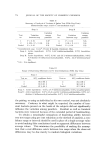
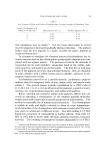
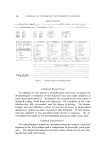
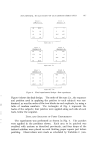
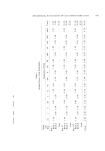
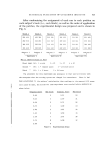
STATISTICAL EVALUATION OF CUTANEOUS IRRITANTS 817 Block' 1 Block 2 (Subject 1) (Subject 2) ad ab c d bc ac cd bd (1) ab c b a abc bcd abd c acd Replicate I Block 3 (Sub,• ect 3) ad ab (1) bc ac cd bd abcd Block 4 (Subject 4) c abc a d bcd abc b acd Replicate II Block 5 (Subject 5) -- (1) ab ac cd ab bc I abcd bd Block 6 (Subject 6) Figure 4. bcd c b abc acd d a abd Replicate III Final experimental design--first experiment Figure 4 shows the final design. The order of the runs (i.e., the sequence and position used in applying the patches to each subject) was ran- domized, as was the order of the two blocks in each replicate, by using a table of random numbers. The rectangles of Fig. 4 represent the backs of the subjects four patches were applied along each side of each back, below the scapulae. DATA AND ANALYSIS OF FIRST EXPERIMENT The experiment was performed as shown in Fig. 4. The patches were applied in the positions shown. Each area to be patched was swabbed with acetone as described previously, and four drops of the irritant solution were placed on each blotting paper square just before patching. Observations were made as scheduled by Variables C (con-
Purchased for the exclusive use of nofirst nolast (unknown)
From: SCC Media Library & Resource Center (library.scconline.org)