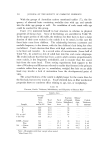
168 JOURNAL OF THE SOCIETY OF COSMETIC CHEMISTS polarized and contributes to the sense of sheen or gloss smooth coatings like oils increase the mirror-like reflectance, and particulate deposits such as dirt, detergent residue, or hair spray particles decrease it. A smooth cuticle and a regular cross section lead to maximum reflectance. Greater scaliness and the presence of lateral ridges along the shaft (said to be present in some Negro hair) or a crenulated, irregular cross-sectional shape result in a more diffuse reflection pattern. The reflected light has the same spectral char- acteristics as the incident light--"the hair shines with the same color as the illuminant"--and thus the tonal characteristic of the innate hair color is diluted. The absorbed light that is re-reflected is selective with respect to wave- length. The maximum absorption is in the near UV, about 400 m/•, and the minimum absorption is at 700 m• and beyond. In the visible region, the curve of reflectance with wavelength is quite linear over the range of 400- 700 m/•, with a slight upward curvature for reddish tone hair (30). Other things being equal, two pigment characteristics influence the reflectivity after absorption: the size of the pigment particles and their density of distribution. These factors plus the depth of the pigment bed--i.e., the length of the absorption path--affect the color. Darkening with aging may be related to the larger diameter discussed earlier, but there is also evidence for increase in size and number of pigment granules as well. A small fraction of light transmitted through the hair exhibits a different spectrum from that for absorption and reflectance it is redder due to scattering by the pigment granules. Since the incidence of medullation increases with aging, scattering from this cause would be expected to increase and to result in reddening of the hue with age. It may be desirable here to sketch an over-all basis for the existence of various kinds of natural hair color. Color in hair is produced by pigment particles (brownish-black melanin granules) dispersed in a clear transparent matrix of hair keratin substance. The principal difference in the appearance with respect to blondness or brownness is a consequence of the number of pigment granules present. A high density of pigment leads to the appearance of brown or dark hair and a low density of pigment to blonde. An analogous situation is seen in screen printing, where the density of black dots on a printed page affects the visual appearance of darkness or lightness. It seems reasonable to suppose that production of melanin pigment increases with age, and thus more granules per fiber are present in older people. in addition to the melanotic brown pigment, there may also be present a much more diffusely dispersed or "soluble" red-gold stain throughout the

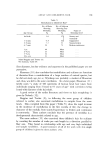
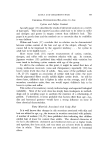
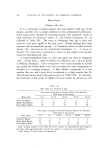
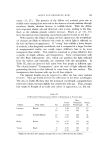
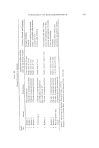
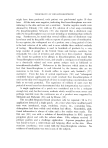
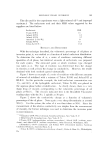
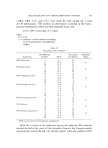
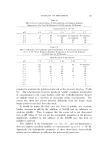
ADULT AND CHILDRENS' HAIR 169 cortex (11, 27). The presence of the diffuse red material gives rise to reddish tones varying from true reds in the absence of much melanin through strawberry blonds, chestnut browns, to reddish blacks. With the diffuse red component absent, ash and drab hair color is seen, tending to the blue- black as the melanin granule content increases. Flesch et al. (31, 32) have discussed an iron-containing nonmelanin pigment found in red hair. With regard to the subject of aging and hair appearance, the morphologi- cal changes are likely to influence the mode by which light is reflected on the hair and hence its appearance. If "young" hair exhibits a lower density of melanin, is less frequently medullated, and is composed of a larger fraction of nonpigmented cuticle, one would expect children's hair to be more transparent than adults'. This might be construed as giving children's hair a quality of depth, softness, and transparency. Some measurements with the Den Beste reflectometer (33), which can partition the light reflected from the surface and internally, are consistent with this speculation. In Table IX, data are given for hair taken from four people at different ages. The column headed "Transparency" gives the ratio of light reflected after penetrating the hair to that believed to come from the hair surface. The transparency does decrease with age for all four subjects. The pigment density may be expected to affect the hue, since melanin is brown. Thus age should increase the reflectance in the lower wavelengths. The data in Table IX show that the dominant wavelength, computed from tristimulus values, increases slightly but consistently with age. Thus, younger hair might be thought of as cooler and calmer in appearance, i.e., less red. Table IX Reflectometer Measurements of Hair of Individuals at Several Ages Hue, Trans- Dominant Purity, Subject Hair Color Age parency a Wavelength % Lavonne Blonde 5 1.26 578 17 10 1.12 581 20 Lynette Reddish-Blonde 10 1.05 580 51 14 0.69 584 28 Becky Brown 3 « 0.76 579 24 7 0.66 585 20 Vivian Black 8 0.85 589 20 21 0.55 604 11 "Ratio of rcfiection after passagc through hair to that reflected from the surface.
Purchased for the exclusive use of nofirst nolast (unknown)
From: SCC Media Library & Resource Center (library.scconline.org)