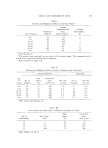
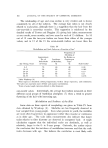
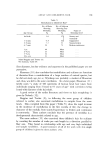
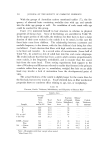
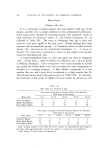
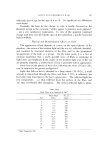
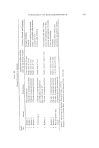
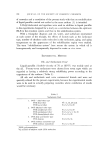
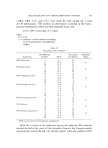
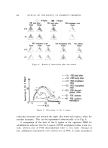
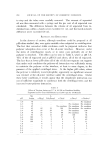
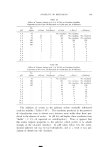
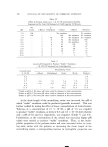
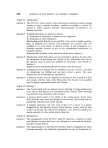
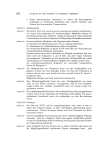
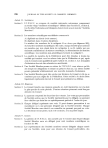
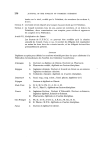
166 JOURNAL OF THE SOCIETY OF COSMETIC CHEMISTS HAIR COLOR Changes with Age It is a commonly accepted opinion that hair darkens with age of the subject, and this view is amply confirmed in the anthropometric literature. Some typical data obtained by matching against color standards (made of dyed swatches) for American whites (5) and French Canadians (6) are collected in Table VII. The trend to darkening with age is clear and seems to occur most rapidly in the early years. Similar findings have been reported with all population groups: in Virginians, Danes, Swedes, French, Czechs (26), and even in very dark-haired Australians (7). A review by Trotter (27) notes many comments by others on this subject and discusses means for describing hair color. A useful longitudinal study on color and aging was done by Steggerda (28). In this work, a series of children was followed over a 10-year period in Holland, Michigan. Color comparisons were made annually by match- ing against the Fischer-Saller scale and converting the letter designations to numbers for averaging purposes. A light blonde corresponds to a low number like one, and a pure black corresponds to a high number like 24. The relevant information in this paper is given in Table VIII. In substance, the head hair of this group of children becomes darker by almost one unit Table VII Hair Color as a Function of Age • Percentage of Samples of American Hair of the Specified Hair Color in Age Group Hair Color 0-9 10-19 20-29 30-49 50-79 White-Lt. Blonde 19 3 0 0 0 Blonde-Dark Blonde 61 44 35 25 16 Brown-Brown Black 20 53 65 75 84 Percentage of Samples of French-Canadian Hair of the Specified Hair Color in Age Group Hair Color 0-4 5-9 10-14 15-19 20-29 30-89 White-Lt. Blonde 15 3 0 0 0 0 Blonde-Dark Blonde 50 22 4 2 2 3 Brown-Brown Black 35 75 96 98 98 97 Note: A small number of red colors have been omitted in computing the percentages in this table. Only pigmented fibers read by the authors i.e., senile gray not considered. •After Trotter (5) and Trotter and Dawson (6).

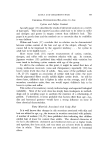
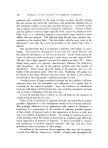
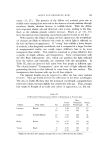
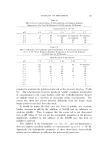
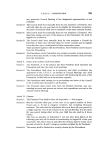
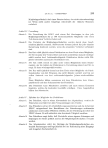
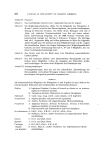
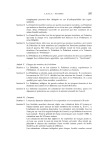
ADULT AND CHILDREN'S HAIR 167 with each year of age for the ages of 6 to 18. No significant sex differences were found. Curiously, the basis for the change in color is hardly discussed in the literature except as the comment, "adults appear to generate more pigment" not a very satisfactory explanation. In view of the apparent continued change with time over the full life span of the individual, a specific hormonal basis is unlikely. Physical and Morphological Effects on Color The appearance of hair depends, of course, on the optical physic of thc situation--the nature of the incident light and the way it i reflected, absorbed, and scattered by structural clements of the fiber and by the geometrical arrangements of the hairs as a group. On the latter point, it is a fact of common experience that a neatly parallel array of fibers is conducive to high luster and brightness if the angles of the incident light and of the eye are properly disposed a tousled head of hair is generally dull in appearance. Some facts on the physics of hair color, following the views of Garn (29), may be instructive for general background. Light that falls on hair is absorbed to a large extent (70-95%), a small amount is transmitted through the fiber, and from 2-20% is reflected--the last being most important in the hair's appearance. The reflected light has two components: (a) that reflected from the surface of the fiber, and (b) that re-reflected after absorption. The surface-reflected light is plane- Table VIII Hair Color as a Function of Age • Mean Hair No. of Age Color Cases 6 5.5 80 7 6.4 178 8 7.6 224 9 8.7 218 10 9.2 246 11 10.2 267 12 11.1 285 13 11.9 304 14 12.5 307 15 13.5 302 16 14.3 219 17 15.2 128 18 15.7 43 "After Steggerda (28).
Purchased for the exclusive use of nofirst nolast (unknown)
From: SCC Media Library & Resource Center (library.scconline.org)