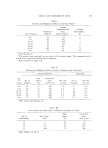
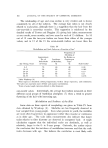
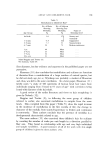
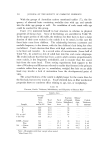
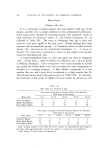
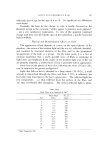
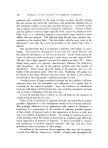
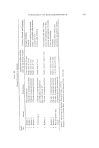
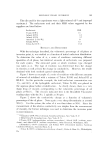
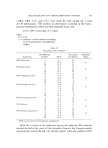
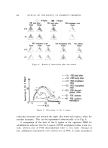
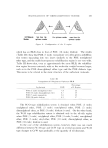
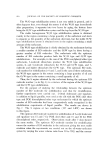
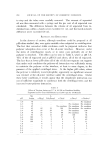
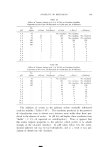
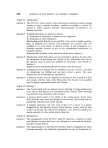
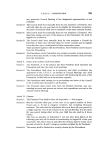
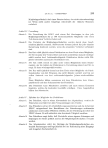
160 JOURNAL OF THE SOCIETY OF COSMETIC CHEMISTS hair is short, fine, and usually unpigmented the downy underfur of some mammals and the fine body hair of children and women are probably characteristic. Some authors restrict the term vellus to such fibers rather than to any type of scalp hair. The tertiary, or terminal, hair is normally considered to be long, coarse, and pigmented, and associated with the mature individual. There is considerable overlap in the various types, and on any given animal or in any specific region of the skin all types may be evident, as well as intermediate varieties. Most anthropologists view the changes that take place as developmental, whenever the transition from the primary through the terminal types occurs with increasing age (1-3). A corollary of this view is that the changes do not occur all at once, and that at any given time some fraction of the more primitive hairs may be present. Thus, Danforth (1) observes that between 6 and 21% vellus hairs may still be present in late childhood during the transition to terminal piliation. DIMENSIONS AND MORPHOLOGY Cross-Sectional Size and Shape o[ the Hair Both of these characteristics have usually been measured together on the same samples. In an early paper, Wynkoop (4) concludes that "hair shaft diameter bears little or no relationship to the age of the individual, though there seems to be a rough correlation . . . with age group of individuals .... " Examination of her data indicates that the 0- to 9-year age group of hair samples does have substantially finer hair than the samples of older groups measured. Trotter and her coworkers (5-7) investigated these hair characteristics more thoroughly by using a somewhat better technique. Some data from these sources, regrouped and rearranged, are given in Tables I and II. These results show the average increase in linear density and of cross-sectional area with age at least through the teen years. There is also a suggestion o[ a modest decline with older age groups. The ellipticity, as measured by hair index, does not in these data correlate with age. It is emphasized that these results are averages and that each head contains individual fibers of a wide range with much overlap among the age groups. In view of the subject-to-subject variability, the results from two additional papers by this group of workers are more conclusive (8, 9). The hair index and size of a small group of children were followed by sampling their heads on a regular time schedule from birth through early teen age the data are given in Table III.

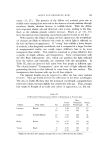
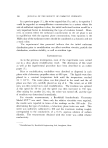
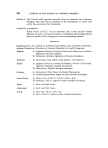
ADULT AND CHILDREN'S HAIR Table I Fineness and Ellipticity of Hair of American Whites" 161 Age of Group Average Cross-Sectional Average Number of Area, Hair Index, Subjects Square "Units "b 0-4 24 31} 75 5-9 42 42 10-14 40 } 73 47 15-19 35 56 20-29 55 50 77 30-49 100 51 74 50+ 44 46 76 •From Trotter (5). bThe precise units employed are not clear in the original paper. The computed area is bascd on the microscope scaling device employed. CRatio of minor to major axis. Table II Fineness and Ellipticity of Hair of French Canadians and Americans • French Canadians Americans Age Hair Cross-Sect. of No. of Index, Area, Wt./100 No. of Group Subjects % mm 2 X l0 s cm, mg Subjects Wt./100 cm, mg 0-4 46 73 268 3.4 17 5-9 36 74 341 4.2 37 10-14 45 74 378 4.7 36 15-19 46 73 425 5.4 38 20-29 52 72 422 5.3 55 30+ 75 72 380 4.7 137 2 9 3 9 45 53 46 45 •After Trotter and Dawson (6). Table III Cross Section and Hair Index of Children from B•rth to Youth • Individuals Hair Age Group, Index, years Cross-Sect. Area, mm 2 X lO s 15 I 76 75 16 2-4 7O 237 16 5-9 72 312 11 10+ 73 336 •After Trotter et al. (8, 9).
Purchased for the exclusive use of nofirst nolast (unknown)
From: SCC Media Library & Resource Center (library.scconline.org)