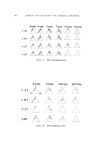
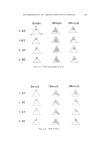
J..%c. Cosmetic Chemists, 20, 185-198 (March 4, 1969) Effect of Initial Surfactant Location on Emulsion Phase Inversion TONG JOE LIN, Ph.D., and JOHN C. LAMBRECHTS, B.S? Presented May 14, 1968, Filth IFSCC Congress, Tokyo, Japan Synopsis The voluxne of the internal phase at the point of inversion, q•, was examined as a function of the initial surfactant distribution in the oil phase and the aqueous phase. Experimental data obtained with a series of nonionic surfactants and two types of oils indicated that, in addition to the type of surfactants, the initial distribution of the surfactant played an important role in determining the type of emulsion formed. Placing of more hydrophilic surfactant in the aqueous phase initially favored a formation of an O/W emulsion and increased the value of q•. The experimental data suggested that the rate of migration of the hydrophilic surfactant from the oil phase to the aqueous phase was not instantaneous but required a finite time. The results were qualitatively consistent with the theory of Davies. INTRODUCTION Since the type of emulsion often has significant effects on viscosity and texture, as well as stability, controlling phase inversion is important to cosmetic chemists not only from the product development viewpoint but also [rom the manufacturing viewpoint. Although phase inversion of an emul- sion is a well-known and widelv encountered phenomenon, the precise mechanism is not well understood. Among the many factors which influence the emulsion type, the surfactant employed to stabilize the emulsion is considered very important. In an earlier work, the writer discovered that, in addition to the surfactant type and concentration, the initial surfactant location prior to emulsification also Max Factor and Company, 1655 North McCadden Place, Hollywood, Calif. 90028. 185

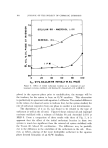
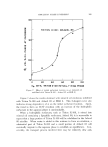
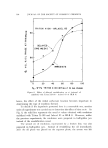
186 JOURNAL OF THE SOCIETY OF COSMETIC CHEMISTS played a significant role in deciding the type of emulsion formed (1). By varying the initial distribution of surfactants in the oil phase and aqueous phase, while keeping all other factors constant, it was possible to prepare emulsions having different physical properties. The purpose of this work is to extend the original exploratory findings further and to determine precisely how the initial surfactant location affects the emulsion type. More specifically, the per cent volume of the internal phase at the inversion point, 4, was studied as a function of the initial distribution of surfactants in the oil and aqueous phases. THEORETICAL CONSIDERATIONS The simple phase volume theory of Ostwald (2) proposes that an emulsion will invert when the internal volume exceeds 74.02%. This volume is geometrically derived from the volume occupied by an internal phase consisting of closely-packed, uniform spherical droplets. Although this theory is reported to be applicable to some systems (3), it does not provide a realistic picture for many practical emulsions having wide droplet size distribution or distorted droplets. It is known, for example, that stable O/W emulsions can be prepared with the oil phase well above 90%. It has been recognized for many years that, in addition to the volume of the internal phase, the type of emulsifying agent also has a marked effect on the emulsion type (4). In 1913, Bancroft (5) pointed out an important relationship between the solubility of an emulsifying agent and the type of emulsion. A general rule, derived from Bancroft's work, states that the continuous phase of an emulsion will be the phase in which the emulsifier is most soluble. In terms of the modern HLB (hydrophile-lipophile balance) concept, it has been shown that low HLB surfactants tend to form W/O emulsions and high HLB surfactants tend to form O/W emulsions (6). It has not been until recent years, however, that the concentration of surfactants has been recognized as an important factor in determining the type of emulsion formed. Sherman (7) studied a serie:, of emulsions stabilized with sorbitan sesquioleate and found that 4, the phase volume at which inversion occurs, increases with the amount of the surfactant until its concentration reaches 3.5%. Later, Becher (8) also reported that both the surfactant type as well as the surfactant concentration have significant influence on 4. The importance of the surfactant concentration was also pointed out by Griffin et al. (9) who conducted a series of experimental work with various types o[ oils stabilized with nonionic surfactants.
Purchased for the exclusive use of nofirst nolast (unknown)
From: SCC Media Library & Resource Center (library.scconline.org)