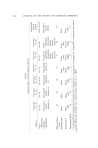
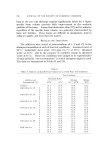
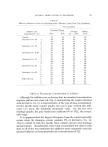
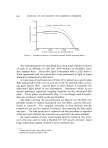
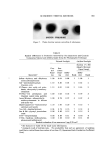
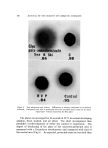
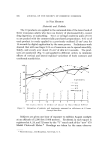
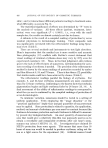
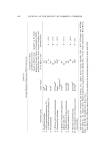
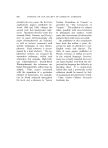
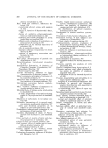
786 JOURNAL OF THE SOCIETY OF COSMETIC CHEMISTS long as the per cent drainage remains significantly below 60, a higher specific foam volume provides little improvement in the aesthetic qualities of the foam. Foams that drain more than 70% in five minutes, regardless of the specific foam volume, are generally characterized by large wet bubbles. These foams are difficult to manipulate, tend to collapse rapidly, and feel relatively watery. RESULTS AND DISCUSSION The additives were tested at concentrations of 1, 2 and 5% in the shampoo formulation at each of four test conditions: deionized water at 23øC moderately hard water (150 ppm Ca ++) at 23øC deionized water at 45 øC and in the presence of synthetic sebum in deionized water at 45 øC. These test conditions were judged to be representative of some probable "use-environments" in which shampoos might be used. The data are summarized in Tables II and III. Table II Effect of Additives on Specific Foam Volume (ml/g) Under Four Test Conditions Test Condition Deionized Water Additive and 150 ppm Sebum, Concentration (%) 23 ø C 45 ø C Ca + +, 23 ø C 45 ø C Control 14.1 14.8 13.6 13.2 Derivative No. 16 1 14.4 14.7 14.4 13.3 2 14,8 14.3 15.0 14.0 5 14.4 13.1 13.6 13.5 Derivative No. 25 1 14.2 14.0 14.0 14.0 2 14.3 12.8 14.6 13.8 5 14.2 13.4 14.8 12.7 Derivative No. C-24 1_ 14.8 13,5 13.6 13.5 2 13.8 13.4 15.7 13.0 5 14.2 13.2 13.8 12.7 Derivative No, 75 1 13.9 13.8 13.9 13.5 2 13.7 14.0 12.8 14.3 5 14.0 13.6 16.3 13.9 Derivative No. 97 1 14.1 13.9 14.4 13.7 2 14.0 13.9 15.0 13.3 5 13.1 13.2 14.7 14.4 Derivative No. 98 1 13.8 14.8 14,7 12.9 2 12.5 14.5 14.6 13.3 5 13.7 14.4 14.0 12.5 POE (10) S.A. i 14.3 13.3 15.4 13.3 2 14.2 13.3 14.2 12.5 5 13.4 13.3 13.4 13,4

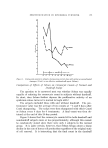
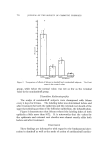
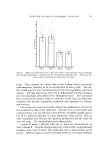
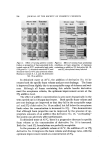
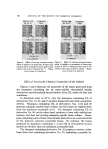
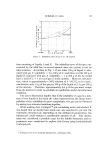
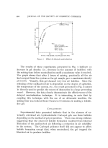
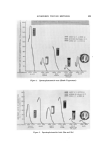
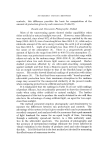
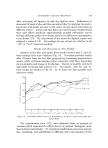
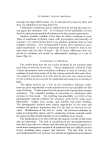
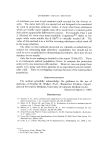
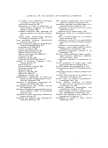
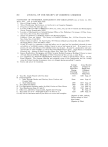
LANOLIN DERIVATIVES IN SHAMPOOS 787 Table I I I Effect of Additives on Per Cent Drainage after $ Minutes Under Four Test Conditions Test Condition Deionized Water Additive and 150 ppm Sebum, Concentration (%) 23øC 45øC Ca ++, 23øC 45øC Control 56 69 57 63 Derivative No. 16 1 64 65 61 64 2 64 7O 65 67 5 67 67 59 61 Derivative No. 25 1 61 67 59 61 2 62 65 55 63 5 64 63 59 63 Derivative No. C-24 1 64 63 55 67 2 59 64 60 61 5 61 68 55 68 Derivative No. 75 1 62 64 60 63 2 62 70 57 56 5 67 62 72 63 Derivative No. 97 1 67 65 58 60 2 58 68 61 60 5 60 65 61 64 Derivative No. 98 1 59 68 57 65 2 60 69 61 61 5 57 70 59 51 POE (10) S.A. 1 56 69 65 60 2 57 59 59 61 5 55 53 53 60 Effect of Varying the Concentration of Additive Although the additives are so diverse that no standard concentration response pattern was observed, Fig. 3, summarizing the results obtained with derivative No. 16, is representative of the type of data accumulated. On the specific foam volume graphs, the heavy gray vertical line indi- cates 13.5 ml/g, the minimum acceptable value. On the per cent drainage graphs, the gray shaded area indicates 60 to 70%, the accept- able range. It is apparent that the largest divergence from the control generally occurs when the shampoo system contains 2% of derivative No. 16. This is evident in both the specific foam volume and per cent drainage measurements. Examination of the total accumulated test data reveals that at all of the test conditions the additives most commonly exert the greatest influence on foam properties at a concentration of 2%.
Purchased for the exclusive use of nofirst nolast (unknown)
From: SCC Media Library & Resource Center (library.scconline.org)