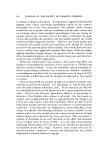
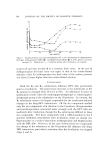
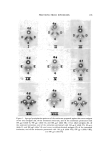
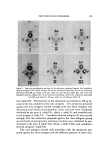
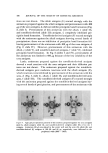
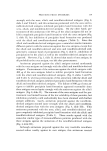
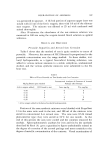
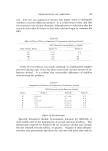
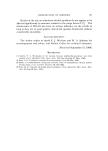
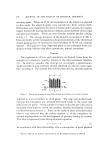
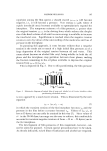
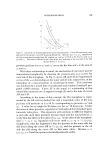
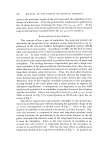
GEOMETRY OF EMULSIONS 151 c.. d. d. ½. Figure 9. Transition from sphere Figure 10. Transition from sphere to RDH to TKDH solute size. This geometrical factor turns out to be the expression: This factor is constant for any particular geometric configuration and characteristic of the specific configuration. In other words, all cubes have the same relationship between their volume and their surface when calculated by this factor even though the absolute values of the volume and surface may vary. Similarly, all spheres, all RDH's, all TKDH's, and all transitional shapes have characteristic values for this factor. The value of Fa has been calculated for a series of transitional shapes from the undistorted sphere to the complete polyhedron for both the RDH and TKDH packing. The results of these calculations are plotted in Fig. 11. i 9O Vol•m• • In•'e•'n•l Pha• Figure 11. Tesselation transitions

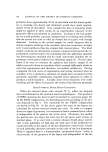
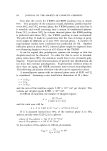
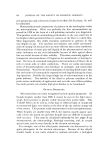
152 JOURNAL OF THE SOCIETY OF COSMETIC CHEMISTS Note that the curves for TKDH and RDH packing cross at about 94%. The geometry of the situation would, therefore, predict that be- tween 68% and 74% internal phase, the TKDH pattern can exist but it is unstable and would rearrange into a system of undistorted spheres. From 74% to about 94% by volume internal phase, the RDH packing is preferred and above 94%, the TKDH packing is most economical. The plot of Fig. 11 leads to a prediction that the rate of change of prop- erties might be different at or near 94% internal phase. A number of experimental studies have confirmed this prediction (9, 10). Another inflection point at about 96.4% internal phase might be expected since now flattening begins to occur on all 14 faces of the TKDH. It can be argued that polydisperse systems can arrange so that the droplets need not be distorted. In order for this to occur at internal- phase ratios above 90%, the emulsion would have to be extremely poly- disperse. Experimental determinations of particle size distributions do not show this extreme polydispersity. Experimental evidence seems to show that, on aging, the HIPR emulsions tend toward monodispersity. The following calculation will show why this can be expected to occur. A monodisperse system with an internal phase ratio of 82.21 vol % is considered. Assuming a unit tessellation dimension of 10 t• then: r = 0.52t• a= 10/• h = 0.02 t• and the area of the interface equals 3.382 X 10 o cm 2 per droplet. The volume per droplet equals 0.5821 X 10 -9 cm a. In 100 ml of emulsion, the number of droplets equals: 82.21 cm a N= 0.5821 X 10⁻⁹cm a and the total area will be A = N X 3.382 X 10 -6 tin 2 = 4.7762 X 105 cm 2 If it is assumed instead that 70% of the internal phase is in 10-t• spheres and the other 12.21% in 1-t• spheres: volume of 10-/• spheres = 4/•- (5 X 10⁻⁴)acm 3 area of 10-/• spheres = •-(10 X 10-4)2cm 2 So the number of 10-v spheres in 100 ml of emulsion 70 N•0t• = X 10 •2 x
Purchased for the exclusive use of nofirst nolast (unknown)
From: SCC Media Library & Resource Center (library.scconline.org)