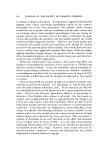
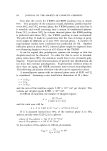
GEOMETRY OF EMUI•SIONS 153 and total area of 10-/• spheres 70 70 X 3 A10• = •,• ,- X (5) :• X 101' X ,•(10 -•) = , 4 X 5 X 5 X 5 X 10*•cm" A10/-t = 4.21 X 10acm s Similarly, the number of 1-• spheres 12.21 12.21 12.21 X 3 X 10 la •V'l/Z = 4/•71'(0.5 X 10-4) a 4/,Or(0.5)a X 1012 = 4•'5 X 5 X 5 and the total area of the 1-/• spheres -- 12.21 X 3 A• = 4•r5 X 5 X 5 x 1015 x •-(1 X 10⁻⁴) 2 12.21 X 3 A 1• = X 107ertl s 4X5X5X5 Alg = 7.3 X 10⁵ Cnl 2 Total area: A,: 11.5 X 10 • c m2. Thus, it can be seen that the monodisperse, flattened configuration has a total area of 4.78 X 10 • c m2 while the polydisperse configuration has a total area ot• 11.5 X 10 • C m2, and that the small droplets in the poly- disperse configuration represent over half of the total area. Remember- ing also that the smaller droplets, having a shorter radius of curvature, will possess a higher internal pressure and will probably have more difficulty in maintaining a coherent film on the more curved surfaces, it would seem reasonable to postulate that the most likely way for this system to reduce its total energy is by the coalescence of the smaller drop- lets. It seems clear then that although, theoretically, highly polydis- persed configurations can be used to achieve high internal phase ratio e•nulsions, they would require significantly higher inputs of energy to produce the increased surface areas and would probably be less stable since the smaller droplets would possess most ot• the energy of formation. SUMMARY The overall geometric model can now be used as a guide in the selec- tion of the type of emulsion to choose for a particular purpose. Certain basic principles can be applied, for example: 1. If low viscosity emulsions are desired, one should: (a) Keep the internal-phase ratio below about $0% by volume. (b) Obtain stability by using charged emulsifiers.

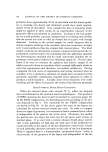
154 .JOURNAL OF THE SOCIETY OF COSMETIC CHEMISTS (c) Choose the emulsifiers to avoid fiocculation and clumping. (d) Process to obtain small particle size to avoid creaming. (e) Keep the viscosity of the external phase low. 2. If high viscosity emulsions are desired, one should: (a) Use medium to high internal phase ratios. (b) Use emulsifiers that inhibit coalescence. (c) Raise the viscosity of the external phase. (d) Introduce controlled fiocculation or clumping. 3. If the concentration of active ingredient must be kept low for eco- nomic, medical, or other reasons, one can: (a) Put the active component in the internal phase of a LIPR emulsion to obtain a fluid emulsion. (b) Put the active component in the external phase of a HIPR emulsion to obtain a thick, smooth, noncreaming formula- tion. (c) Suspend the active component as a finely divided solid in the internal phase o[ MIPR or HIPR emulsion to obtain a non- Newtonian flowable, but nonsettling, composition. (Received September 15, 1969) REFERENCES (1) Einstein, A., Determination of molecular dimensions, Ann. Physih, 19, 289 (1906) A new determination of molecular dimensions, Ibid., $4, 591-2 (1911). (2) Guth, E., and Simka, R., The viscosity of suspensions and solutions. III. The vis- cosity of sphere suspensions, Kolloid-Z., 74, 266-75 (1936). (g) Eilers, H., The viscosity of emulsions of a highly viscous substance as a function of concentration, Ibid., 97, $15-21 (1941) Viscosity-concentration relations of colloid sys- tems in organic solvents, Ibid., 102, 154-69 (1943). (4) Sherman, P., Water-in-oil emulsions. I. Influence of disperse-phase concentration on emulsion viscosity, J. Soc. Chem. D,d. (London), 69, Suppl. •2, 570M• (1950). (5) Mooney, M., Secondary stress in viscoelastic flow, J. Colloid Sci., 6, 96-107 (1951). (6) Goldsmith, H. L., and Mason, S.C., The microtheology o[ dispersions, in Eirich, F. R., Rheology: Theory and Applications, Vol. 4, Academic Press, New York, 1967, pp. 86-250. (7) Gardner, Martin, New Mathematical Diversions from Scientific American, Simon and Schuster, New York, 1966, Chap. 7, pp. 82ff. (8) Toth, L. Fejes, Regular Figures, Pergamon Press, New York, 1964, pp. 288ff. (9) Lissant, K. J., The geometry of highdnternal-phase-ratio emulsions, J. Colloid Inter- [ace Sci., 22, 462-8 (1966). (10) Nixon, J., and Beerbower, A., Properties of high-internal-phase emulsions Part 1, Effect of emulsifier parameters, Preprints, Div. Pet. Chem., Am. Chem. Soc., 14(1), 49-59 (Mar. 1969).
Purchased for the exclusive use of nofirst nolast (unknown)
From: SCC Media Library & Resource Center (library.scconline.org)