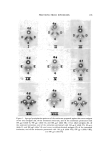
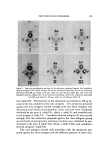
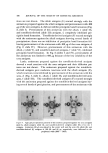
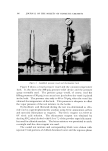
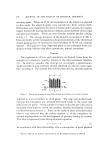
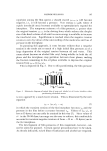
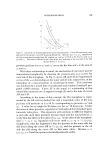
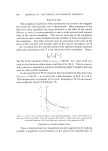
GEOMETRY OF EMULSIONS 143 In some cases, however, quite dilute emulsions exhibit flow proper- ties at considerable variance with the model. In most of these instances, it is found that the individual droplets are sticking together and "clump- ing," "chaining," or "flocculating." Studies by Goldsmith and Mason (6) show that nonspherical particles show more resistance to flow than spheres and that the actual rheology of the emulsions is in accord with such a revised model. Mathematical studies by Hilbut, Heesch, and Loves, as discussed by Gardner (7) and Toth (8), have shown that monodisperse spheres can form stable packings with volume per cents of 5.55 to 12.3 vol %. Such packings would have the effect of the emulsion setting to a "gel" on standing and then thinning out on agitation. MEDIUM INTERNAL PHASE RATIO EMULSIONS Emulsions with internal phase ratios ot• 30 to 50 vol % become in- creasingly viscous and their flow behavior becomes non-Newtonian. Above 50 vol %, the emulsions are quite viscous and highly non-New- tonian. This behavior is in excellent agreement with the basic "cloud of spheres" model. At this point, let us study briefly the purely geometric problem ot• l egular arrangements ot• equal sized spheres in three dimensions. This problem can most easily be approached by investigating the regular poly- hedra which will tessellate in three dimensions. A figure is said to tessel- late when a group of them may be fitted into a regular pattern so that they fill the space with no gaps. Of the five regular Platonic polyhedra only the cube will t•orm a three dimensional tessellation. There are, how- ever, two semiregular polyhedra which will tessellate in three dimensions. These are the rhomboidal dodekahedron (RDH) and the truncated octahedron, tetrakaidecahedron (TKDH). Figure 2 shows the regular cubic tessellation, Fig. 3 shows a rhomboidal dodecahedron, and Fig. 4, its tessellation. Figure 5 depicts a variant of the rhomboidal dodeca- hedron, sometimes referred to as a double bee cell. This polyhedron has the same volume and area as the rhomboidal dodecahedron and its tessellation is shown in Fig. 6. The tetrakaidecahedron is shown in Fig. 7 and and its tessellation in Fig. 8. It turns out that the problem of the closest packing of spheres is directly associated with the problem of three dimensional tessellations. For it• one inscribes a sphere into each poly- hedron in the previously depicted tessellations we get the sphere packing arrays which we are seeking.

144 .JOURNAL OF THE SOCIETY OF COSMETIC CHEMISTS Figure 2. Cubic packing Figure 3. Basic RDH
Purchased for the exclusive use of nofirst nolast (unknown)
From: SCC Media Library & Resource Center (library.scconline.org)