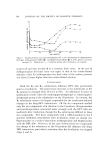
202 JOURNAL OF THE SOCIETY OF COSMETIC CHEMISTS cause as the molecular weight of the oil is increased, the solubility of octa- decane in it decreases. Thus, the potential for octadecanol to partition to the oil phase decreases, flattening the slope of its (7o/w)• curve. At the same time, more of the alcohol partitions to the interphase where the peak soap/alcohol pressure is passed before the (7o/w)• curve reaches it. EXPLANATION OF HLB SCHEME This concept of how a pair of emulsifiers like soap and alcohol can determine the properties of an emulsion system leads directly to an ex- planation of the role that Griffin's hydrophilic-lipophilic balance (HLB) scheme plays in such systems. According to Griffin, the HLB of an emul- sifier is an expression of its "relative simultaneous attraction for water and for oil" (3). In other words, it is the potential of an emulsifier to parti- tion between the two phases. This is exactly similar to the potential of the alcohol in the system described to partition between the oil phase and interphase. The analogy between a soap-alcohol pair and a single non- ionic emulsifier of the polyoxyethylene class becomes clear when one con- siders that most of these commercial nonionics are mixtures of short- and long-chain ethylene oxide derivatives. Thus, the short-chain fractions, which are less water-soluble, behave as alcohols whereas the longer frac- tions, having large spatial requirements in water, behave like soap (10). Moreover, most of this soap-like emulsifier partitions to the interphase, leaving behind in the water phase only a minor portion to support the adsorption equilibrium. Consequently, it is legitimate to say that HLB measures the potential of an emulsifier to partition between the oil phase and the interphase. Hence one may plot curves of fro and (7o/w)• versus HLB as shown in Fig. 8 by superimposing an HLB scale upon the ab- scissas of Fig. 7. This device equates the total nonionic emulsifier to the alcohol frac- tion of an alcohol-soap pair without changing the (parabolic) shape of the o versus concentration of alcohol curve of Fig. 7. Now as the total amount of emulsifier in the system is increased, =0 at first increases. But, since the nonionic is composed of short- and long-chain ethylene oxide content fractions, the partitioning of the short-chain fraction to the oil phase concomitantly dissolves some of the long-chain fraction, removing it from the interphase. Thus, as the total amount of emulsifier is in- creased, the ratio of short- to long-chain fractions in the interphase in- creases at an accelerated rate. This has the same effect as adding more long-chain alcohol to the soap of the emulsions of Fig. 7. As pointed out

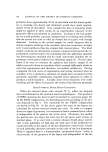
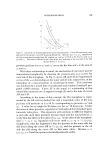
MICROEMULSIONS 203 52dyneScm. KEROSENE-IN-WATER EMULSION ///1 I \ I \ I \ i ! \ ! I I 10 13 15 H LB SCALE Figure $. Characterization of process of emulsification of kerosene-in-water by curves of (•/o/w)a and •'0 versus HLB. Abscissas of points on curves reflect HLB values ordinates, values of thermodynamic functions above, as this alcohol/soap ratio increases, there comes a point at which ,• abruptly decreases. The point at which this occurs depends, of course, upon the initial ratio of short- to long-chain ethylene oxide fractions in the emulsifier or, in other words, upon its HLB. The experimental ob- servation that microemulsions do not form with emulsifiers of the wrong HLB (or wrong chemical type) regardless of the excess used, confirms. this analysis. Under these circumstances, the HLB scale of Fig. 8 indicates the di- rection that the partitioning equilibrium will take in a kerosene-in-water emulsion as the HLB of the emulsifier (of correct chemical type) is raised or lowered. As a general rule, at HLB's higher than 15 most of the emulsifier will be in the interphase. This condition is illustrated by the pair of curves 3-3, in which the depression of (3,o/w)• is slower in develop- ing than the peak film pressure. At HLB 10, as shown in the pair of curves 1-1, most of the nonionic emulsifier will be in the oil phase where it is available to depress (3,o/w)• but is not very effective in elevating =0.
Purchased for the exclusive use of nofirst nolast (unknown)
From: SCC Media Library & Resource Center (library.scconline.org)