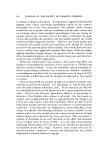
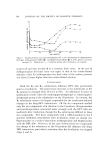
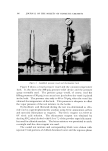
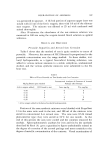
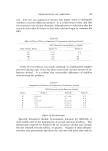
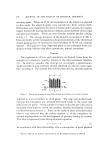
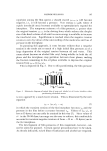
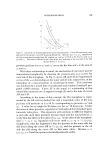
PHOTOSENSITIZED REACTIONS 163 slower secondary change (Fig. 6). Promazine showed no surface pressure either before or after irradiation. It should be noted that chlorpromazine and prochlorperazine both have a chlorine substituent on the 2 position of the phenothiazine nucleus. They differ in their substituent on the 10 position (Table I). Promazine, on the other hand, is identical to chlor- promazine except for a hydrogen on the 2 position instead of a chlorine. Table I Phototoxic Index (PI)• of Six Phenothiazine Derivatives I R•0 Compound R•0 R2 PI Promazine --(CH2)aN(CHa)2 H 0 Chlorpromazinc --(CH2)aN(CHa)2 C1 60 Trifiupromazinc --(CH 2 )aN (CH a ) • CF a 0 Prochlorpcrazinc --(Ctt2),--•/N--CH• Cl 50 Trifluopcrazinc --(CH2) •--•_/N-- CHa CFa --300 0,, Fluphcnazinc --(CH2)•/N-- CH2-- CH2-- 0H CFa --25b +20c See text for definition and method of calculation. Value recorded initially. Value recorded after about 15 minutes. In contrast, all of the trifluoromethyl derivatives (triltuoperazine, triltupromazine, and fluphenazine) showed a rapid decrease in surface pressure which lasted from one to three minutes (Fig. 7). Trifluoperazine and triflupromazine, following this rapid period of change, exhibited a second, slow change which continued for the remainder of the irradiation period. Fluphenazine, however, after about 13 minutes of irradiation reversed its trend and showed a marked increase in surface pressure that persisted for about 25 minutes even though the irradiation lamp was turned off during part of that time. The maximum surface pressure reached by fluphenazine (about 15 minutes after irradiation was stopped) was almost 8 dynes higher than that recorded for the nonirradiated com- pound. The surface pressure of both the triflupromazine and trifluoper- azine solutions increased rapidly for about 25 minutes after the lamp was

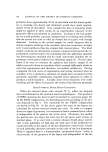
164 JOURNAL OF THE SOCIETY OF COSMETIC CHEMISTS O / .•e" •10 / / •J - i I I I • I , I i 0 I0 20 30 40 TIME, MINUTES Figure 7. Surface pressure versus time of irradiation of 1 X 10⁻⁴M solutions of triflupromazine HC1 (,) trifluoperazine diHC1 (0) and fluphenazine diHC1 (I) at 25øC, pH 5.9, and ionic strength 0.1. Dashed line (---) indicates period after irradiation was stopped turned off and then leveled off to a constant, final, value. In the case of trifiupromazine this final value was equal to that of the nonirradiated solution, while for trifluoperazine the final value of the surface pressure was about 2 dynes higher than the nonirradiated solution. CONCLUSIONS Both the R2and R•0 substituents influence DPL film penetration prior to irradiation. The penetration increases as the substituent at the R,position is changed from H to C1 to CF:4. An additional increase in penetration results when the methylpiperazinylpropyl or ethanolpipera- zinylpropyl group is the substituent on the 10 position. In contrast, the R,substituent seems to be largely responsible for the irradiation-induced changes in the drug-DPL interactions. Of the six compounds studied only the two compounds with chlorine in the 2 position, chlorpromazine and prochlorperazine, interacted more strongly with the DPL film im- mediately after irradiation, though the R•0 substituents differed in these two compounds. The three compounds with a trifluoromethyl in the 2 position exhibited, immediately after irradiation, either no change (tri- flupromazine) or a weaker interaction (trifluoperazine and ttuphenazine) with the DPL film. However, in the case of these latter two compounds the change in the substituent at the 10 position did influence the drug- DPL interaction, particularly sometime after the irradiation was stopped (Figs. 4 and 5).
Purchased for the exclusive use of nofirst nolast (unknown)
From: SCC Media Library & Resource Center (library.scconline.org)