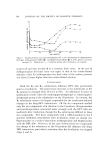
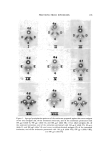
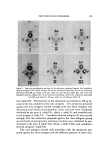
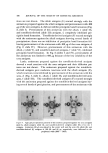
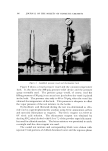
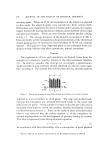
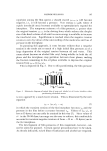
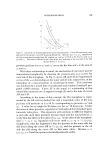
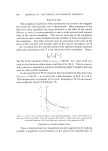
GEOMETRY OF EMULSIONS 147 Figure 8. Tetrakaidecahedral packing known, this is the densest possibility for packing a monodisperse spherical array. Let us see what this may mean in terms of emulsion properties. If it is assumed, as a first approximation, that all of the droplets in an emul- sion are about the same size, then it would be expected that if more than 52% of the volume is occupied by the internal phase droplets, they will have to be deformed as they flow past each other and, therefore, the ap- parent viscosities of emulsions would be expected to increase markedly as the internal phase ratio increases above 52 vol %. This is exactly what is found to happen. Furthermore, slurries of monodispersed solid particles become quite pasty above 52 vol % and exhibit highly non-New- tonian flow behavior. Since the particles in most emulsions are not truly monodisperse, the viscosity transition point would be expected to be somewhat higher than 52%. It would also be expected that highly poly- disperse emulsions, that is, emulsions with a wide range of droplet sizes, would be less viscous than monodisperse emulsions of the same internal- phase ratio. Unfortunately, a search of the literature does not reveal enough data concerning the viscosity of systems of known polydispersity

148 JOURNAL OF THE SOCIETY OF COSMETIC CHEMISTS to confirm or disprove this point. This geometric approach immediately suggests some rather interesting experiments which to the author's knowledge have never been performed. For instance, these concepts would lead one to predict that two emulsions with the same volume per cent internal phase, both essentially monodisperse but one having an average particle size ten times that of the other, would both be quite viscous and probably the emulsion with the smallest particle size would exhibit the highest apparent viscosity. However, one would predict that if mixtures were made of these two emulsions, even though the volume per cent of the internal phase did not change, one would expect the mix- tures to exhibit lower apparent viscosities than either of the two mona- disperse emulsions simply because the geometry of the situation would allow the smaller droplets to fit in between the larger ones and, therefore, result in a less crowded configuration. When the internal-phase ratio reaches a little more than 68%, the droplets of monodispersed emulsions will be forced into a TKDH array and into intimate contact. Unless the emulsifier used in extremely ef- fective in preventing coalescence, the emulsions are unstable. Similarly, a monodisperse emulsion with an internal-phase ratio in excess of 74% is forced into a RDH array and the droplets are flattened at their points of contact. Prior to about 1940, the number of types of emulsifiers available com- mercially was distinctly limited. The true soaps, i.e., salts of fatty acids, were the most common emulsifiers used. These materials are effective for stabilizing emulsions at low phase ratios by a charge repulsion mecha- nism. They are not, however, particularly effective at preventing co- alescence of the droplets when contact is achieved. For this reason, as a phase ratio of approximately 70% is approached and the droplets are [arced into close contact, only those emulsifiers which are able to form stable films and thus prevent coalescence are effective in stabilizing these emulsions. It has only been in comparatively recent times that a wide variety of nonionic, film-forming emulsifiers has been available on the market, and so it is only recently that the commercial production of high internal phase ratio emulsions has been practical. One encounters a number of statements in the early literature to the effect that inversion occurs at phase ratios in excess of 70%. It is true that certain systems employing sodium oleate were reported to make possible the preparation of emulsions in the 90% range. However, more recent work has in- dicated that these "emulsions" were not true emulsions but were rather dispersions of a hydrocarbon in a soap gel.
Purchased for the exclusive use of nofirst nolast (unknown)
From: SCC Media Library & Resource Center (library.scconline.org)