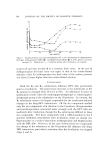
GEOMETRY OF EMULSIONS 149 The "creaming" of emulsions also demonstrates the importance of the closest packing concept. If an emulsion is stabilized against coalescence, each droplet still tends to rise or settle depending on the relative density of the two phases and, unless the particle size is very small, an emulsion will eventually "cream." The cream layer usually is found to contain as a limit about 74% by volume of internal phase droplets. For example, a 10% by volume emulsion will yield a cream layer of about 13.5%. Creamed emulsions can be readily redispersed provided fiocculation or "clumping" has not occurred. Consider a situation where ignoring the geometrical concepts could lead one to misinterpret the results of the laboratory tests. Suppose, as an external phase there is used an aqueous solution of a nonionic emulsi- fier chosen to be very effective in preventing coalescence of droplets. Suppose an oil is added while stirring until a 150% by volume O/W emul- sion is obtained which is reasonably monodisperse with droplets of about 10-t• size. A 100-ml sample is taken and stored in a stoppered, graduated cylinder and labeled sample A. Now the stirring rate is increased and stirring is continued until five parts of the oil volume are still in 10-t• droplets but one part of the volume is reduced to 1-t• size. Another sample is taken and labeled B. Stirring is resumed until four parts of the oil droplets are still 10-t• size and two parts are 1-t• size. Sample C is then taken. Observations of the samples show that sample A clears to an 81-ml layer leaving 19 ml of clear fluid. In other words, 60 ml of internal phase droplets cream until they occupy approximately 74% of an 81-ml cream layer. In sample B, the 50 ml of large droplets occupy 74% of a 67.5-ml cream layer which also contains 17.5 ml of external phase and the small droplets, if by themselves, would occupy 74% of a 15.5-ml layer. However, in the mixture, the small droplets can be dispersed in the 17.5 ml of interstitial external phase, driving out some of the external phase without increasing the total volume of the cream layer. It is, therefore, observed that there is about 32.5 ml of clear fluid below the cream layer. In sample C, the large drops pack into 54 ml with 14 ml of [Tee space. The small droplets cream into 27 ml. Fourteen milliliters of this can fit between the large droplets so that the whole system could cream leaving $$ ml of clear fluid below the cream. Now suppose the remaining emulsion is stirred until it is all in 1-t• droplets (sample D). This again would cream leaving a free space of 19 ml but it would cream much more slowly than sample A. There are now four emulsion samples. The first has creamed showing approximately 19 ml of clear fluid at the bottom. The second and third

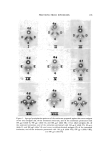
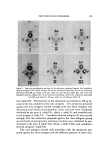
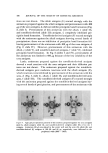
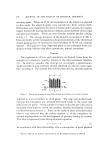
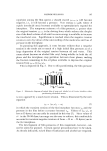
150 JOURNAL OF THE SOCIETY OF COSMETIC CHEMISTS graduates show approximately $$ ml of clear fluid and the fourth gradu- ate is creaming very slowly and ultimately would show again approxi- mately 1 õ ml of clear fluid. Now consider the line of reasoning which might be applied to these results by an experimenter unaware of the geometric effects encountered in emulsions. Looking at the first gradu- ate, he would probably, correctly, interpret this as creaming and consider that the system was close to what he wanted but not quite well enough dispersed. Looking at the second sample, he could interpret this as almost complete breaking of the emulsion, since the cream layer occupies only 7 more milliliters than the original bulk internal phase. The third sample could also be interpreted as almost complete breaking and the ex- perimenter could be lead to the conclusion that the additional agitation was destroying the emulsion and he could conceivably abandon the ex- periment at this point without ever obtaining sample D. On the other hand, if he were to continue the agitation and achieve sample D, he might very well obtain an emulsion which creamed sufficiently slowly to meet this requirement and, theret•ore, was entirely satisfactory. Having completed the full series of experiments and having obtained what he considers to be a satisfactory emulsion, he might then conclude that this particular emulsifier combination required severe agitation in order to produce a stable emulsion. Actually, none of the emulsions were really breaking and the effects were purely the result of the inherent geometry. HIGH INTERNAL PHASE RATIO EMULSIONS When the internal phase ratio exceeds 74+%, either the droplets have to be flattened or the emulsion must be polydisperse. The geometry of HIPR emulsions has been treated in detailed in a previous paper (9). In the RDH configuration, the flattening proceeds according to the pro- cess depicted in Fig. 9. The transitions for the TKDH configuration are shown in Fig. 10. In the above paper, the areas of the figures are calculated for various internal volume per cents. In order to compare these two types of geometry, it is necessary to find a common factor which is independent of the particle size of the array. Obviously, the smaller the particle size, the larger the total area for any given total volume of internal phase. If we start with a certain volume of bulk phase and di- vide it into polyhedra we find that the total area of the polyhedra in- creases inversely as the square of the key dimension, whereas the volume of each polyhedra decreases inversely as the cube of the key dimension. l•rhat is required then is a dimensionless "geometrical factor" which is characteristic of the geometry of the figure and independent of the ab-
Purchased for the exclusive use of nofirst nolast (unknown)
From: SCC Media Library & Resource Center (library.scconline.org)