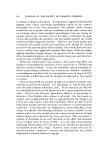
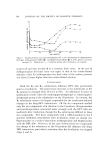
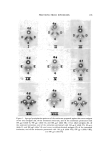
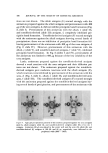
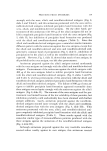
PHOTOSENSITIZED REACTIONS 159 •4 0 40 80 12q •60 AREA/MOLECULE, A •' Figure 2. Surface pressure versus area per molecule for L-c•-dipalmitoyl lecithin on acetic acid- sodium acetate buffer (pH 5.9) at 25øC and ionic strength 0.1. Key: O, zero concentration of triflupromazine HC1, irradiated and nonirradiated I, 1 X 10-•M trifiupromazine HC1, irradiated and nonirradiated radiation of the trifiupromazine-DPL system produced no detectable change. Again, as with promazine, it may be concluded that any photo- species produced apparently interacts with the film to the same extent as the starting compound. The •--A curve of the prochlorperazine-DPL film is slightly more ex- panded than that of either chlorpromazine or triflupromazine, indicating an increased degree of interaction. Irradiation of the prochlorperazine-DPL fihn resulted in an additional increase in area/molecule (Fig. 3), similar to that observed with chlor- promazine, indicating a further increase in the drug-film interaction. Trifluoperazine and ttuphenazine behave somewhat differently than the other members of the group. Both of these compounds penetrate the DPL film to a greater degree than any of the others, exhibiting this effect even at maximum trough area (• 160A=DPL molecule). Irradia- tion, in contrast to the effect observed with the other compounds, resulted in an initial decrease in surface pressure. On compression of the ir- radiated trifluoperazine-DPL film, the =-A curve gradually approached that of the nonirradiated film (Fig. 4). Under similar conditions, the

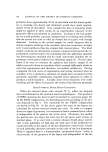
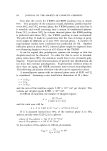
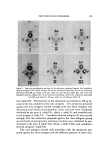
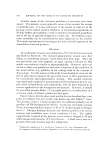
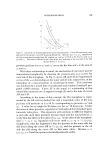
160 JOURNAL OF THE SOCIETY OF COSMETIC CHEMISTS 42 40 80 120 160 AREA/MOLECULE, ,•z Figure 3. Surface pressure versus area per molecule for L-a-dipalmitoyl lecithin on acetic acid-sodium acetate buffer (pH 5.9) at 25øC and ionic strength 0.1. Key: O, zero concentra- tion of prochlorperazine dihydrochloride, irradiated and nonirradiated I, 1 X 10-sM pro- chlorperazine dihydrochloride, nonirradiated a•, 1 X 10-.•M prochlorperazine dihydro- chloride, irradiated fiuphenazine-DPI. system responded the same way, except at areas smaller than 88A -• the film exhibited surface pressures greater than the nonir- radiated film at corresponding areas (Fig. 5). By determining the surface pressure at periodic time intervals it was established that these effects, ob- served only with the trifiuoperazine and fiuphenazine-DPL systems, were a function of elapsed time after irradiation rather than of the increasing pressure. Thus, while the surface pressure of these irradiated films de- creased initially, several minutes after the irradiation was stopped the surface pressure began to increase even when the area/DPL molecule (film area) was maintained constant. In the case of the trifiuoperazine- DPL system this increase continued until the surface pressure was ap- proximately equal to the nonirradiated film. However, in the case of •he fiuphenazine-DPL system, this increase continued until the surface pressure exceeded that of the nonirradiated film by 6-7 dynes/cm. Thus, it appears that the photospecies produced initially by the irradiation is less film active than the starting compounds. With time, apparently, componnds form that interact with the DPL film either to about the
Purchased for the exclusive use of nofirst nolast (unknown)
From: SCC Media Library & Resource Center (library.scconline.org)