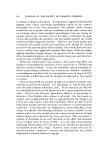
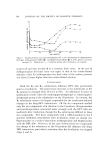
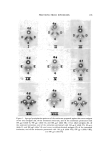
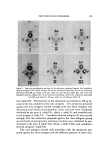
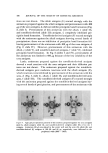
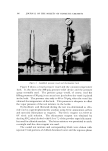
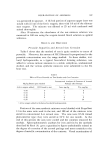
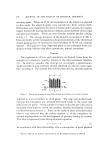
198 JOURNAL OF THE SOCIETY OF COSMETIC CHEMISTS Moreover, it has been found that the maximum pressure is only developed when the ratio of soap to alcohol in these films is between 1:1 and 1:4. On either side of this range, the pressure falls off rapidly. In the case of O/W microemulsions, the nature of the soap cation is also critical. This picture of events at the interface is essentially a mechanical one. It differs from a rigorous thermodynamic treatment in that it requires a stepwise process rather than a single, unified one to account for film cur- vature. In this view, soap in the fiat interphase is penetrated by alcohol derived from the oil phase. This increases the film pressure, tending to expand the fiat film. Acting by another route but in the same direction, the alcohol remaining in the oil phase is available to adsorb to the oil/ water interface and to reduce its tension and thus its tendency to contract. The reality of these forces is apparent in macroemulsions where the excess of (7o/w)•, over =• is the force which shrinks the total interfacial area, caus- ing the two phases eventually to separate. This approach to microemulsion formation leads to a mechanism of film curvature which not only accounts for O/W and W/O emulsions but also for the magnitude of curvature. About fifty years ago, Bancroft (6, 7) proposed that a curved soap film at an emulsion interface was duplex in nature, i.e., it possessed different tensions at each of its sides. Accord- ingly, the side with the higher tension would be concave and would envelop the liquid on that side, making it the internal phase. In Fig. 4 such a duplex film is treated as a fiat interphase with different tensions or pressures at each of its sides. (8). Due to these stresses, curvature occurs, dissipating the pressure •adient until both sides are finally at the same pressure or tension. During this process, the original tension, (7o/w)a, op- posing the pressures does not change. Tw WATER '• x.(• • x, Figure 4. Schematic diagram of mechanism of curvature of flat, duplex film of microemulsion. Stress of pressure gradient due to •ro' and •rw' is relieved by bending until •ro = •rw or •r = (•'o/w)a- Direction of curvature is determined by relative magnitude of •ro' and •rw' The total pressure in these films is equal to the sum of the pressures at each side. Thus, ,r0 is the initial, transient pressure resulting from the

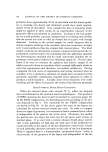
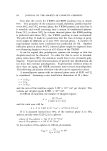
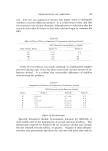
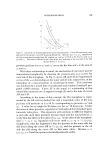
MICROEMULSIONS 199 i E 40? 201 C 10 L % 8o • • 2o Figure 5. Curves of •-• of mixed film of oil/water microemulsion. Curve AB represents water side and CD the oil side curve EF is sum of AB and CD. Because vO (7o/w)•, expansion of the film occurs spontaneously from the original vw • and vo • at 50 • to the final vw and vo at vw and vo. Curvature is effected as the ratio of the area/molecule at the two sides of the film changes from 1/1 to vw/vo pressure •adient due to •o' and •w' across the fiat film and • is the sum o[ =o and =w. With these relationships in mind, the mechanism o[ curvature may be demonstrated graphically by drawing the pressure-area (=-•) curves [or each side o[ the interphase. In Fig. 5, curves AB and CD are hypothetical curves o.[ the =-• relationships at the water and oil side, respectively, o[ the interphase of a microemulsion of octadecane-in-water. This emulsion was stabilized by a mixed film of octadecanol and 2-amino-2-methyl-l-pro- panol (AMP) stearate. Curve EF is the actual =-• relationship o[ this mixed film measured on a Langmuir trough (2) and is the sum o[ curves AB and CD. According to the terms o[ this concept, the fiat interphase is repre- sented by the le[t vertical dashed line and a reasonable value o[ the area per [arty acid molecule in it is 50 •, corresponding to pressures =w' and =o'. A value [or =w' might be 30 dynes/cm [or =o', 10 dynes/cm. Under the stress of these pressures, expansion at both sides o[ the interphase spon- taneously takes place. This expansion will continue, to different degrees, at each side until these pressures become equal and the total pressure, =, in the film has [allen to the value o[ (7o/w)•. At the sides of the interphase, since = = =o + •, expansion will occur until =o: =w -- */2 (7o/w)•. Graphically, what has happened is that the pressure at the water side has slid down along the curve AB to */• (7o/w)• and the pressure at the oil side has slid along the curve CD to this same value. Because = -- (7o/w)•, 7 -- 0 and the system is thermodynamically stable.
Purchased for the exclusive use of nofirst nolast (unknown)
From: SCC Media Library & Resource Center (library.scconline.org)