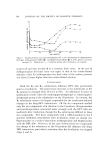
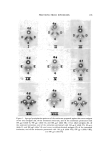
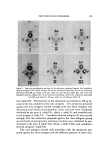
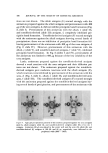
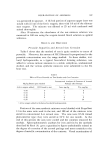
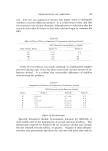
PHOTOSENSITIZED REACTIONS 165 The results obtained in the kinetic studies in the absence of DPL, in general, parallel those of the film studies in spite of differences in drug concentration and irradiation time. This indicates that the initial changes in surface activity induced by the irradiation determine the ex- tent of drug-film interaction. Thus, chlorpromazine and prochlorpera- 7 ..... hi(.l• l•ot-r•rno much more surface ncti,,o an irrndinticm interact with the DPL film much more strongly following irradiation, while for triltupromazine, trifiuoperazine, and ttuphenazine, irradiation reduces surface activity and similarly either reduces or leaves unchanged the drug-film interaction (at least initially). Furthermore, this suggests that in vivo it is not a phenothiazine photo- excited species or free radical that interacts with cellular or membrane components but rather a new, stable, more surface active product of the photoreaction. The high degree of surface activity of this new compound would increase its tendency to accumulate at the membrane-liquid inter- face and conceivably produce the membrane disruption generally associ- ated with the observed clinical sympto. ms of photosensitivity. Willis et al. (7) recently demonstrated that stable photooxidation products of tetrachlorsalicylanilide, rather than free radicals of photoexcited species, are responsible for the observed photosensitized response to this anti- bacterial. To permit comparison of the five phenothiazine derivatives, a photo- toxic index (PI) was calculated using the relationship below. The PI values listed in Table I were calculated at an arbitrarily selected area/ molecule of 75 A •. where: PI • (/xrr•//xrrt) X 100 is the difference between the surface pressure of the irradiate drug- DPL film and that of nonirradiated drug-DPL film is the difference between the surface pressure of the irradiated drug- DPL film and that of the pure lecithin film Thus, PI represents the percentage of the total increase in surface pressure which is due to irradiation of the drug-DPL film. Table I shows that 60% of the total increase in surface pressure that develops in a DPI. film when spread over a subphase containing 1 X 10-•M chlorpromazine and irradiated is due directly to the effect of the irradiation. In the case of prochlorperazine, 50% of the total increase is due to this effect. Irradiation of the other four drug-DPL systems did not produce any initial increase in surface pressure. In fact, in the case

166 JOURNAL OF THE SOCIETY OF COSMETIC CHEMISTS of trifiuoperazine and fiuphenazine the initial value of PI was negative. The significance of this, if any, cannot be determined from the data presently available. Photosensitization reactions have been shown to increase permeabil- ity of a variety of cells, including red blood cells, lysozomes, and mast cells (4). In addition, the observed clinical symptoms are indicative of increased cell membrane permeability. Therefore, it appears reasonable to postulate that the initial increase in film pressure observed in the presence of a DPL fihn on irradiation of chlorpromazine and prochlor- perazine is a measure of a photoproduced cell membrane expansion and subsequent increased permeability. Such increases in film pressure should then be related to phototoxic activity, at least within a series of congeners. Thus, chlorpromazine and prochlorperazine, which showed an increased tendency to penetrate the DPL film on irradiation, would be expected to be phototoxic, while the other compounds would not be to any significant degree. Qualitatively, the literature supports this contention. The bulk of the reports dealing with photosensitization by phenothiazine drugs almost always implicate either chlorpromazine or prochlorperazine, and only rarely other derivatives. Ison and Blank recently ranked chlorpromazine and prochloroperazine based on phototoxicity toward mice (8). These workers determined the PDR50 (i.e., the minimum dose which produces a phototoxic reaction in 50% of a •oup of test animals) of these com- pounds to be 20 mg/kg and 46 mg/kg, respectively. No other pheno- thiazine derivatives were investigated in their study. These data cor- relate with our PI values as shown in Table I. In contrast, based on the available clinical reports, trifiupromazine, trifiuoperazine, and fluphenazine are essentially nonphotosensitizing (9, 10) and promazine has been reported as a photosensitizer in only one .early study (11). It appears that photoproduced changes in both surface activity o.t5 a drug and its ability to penetrate a lipid monomo]ecular film are measures of the photosensitization characteristics of the drug, at least in the case of the phenothiazines. Furthermore, measurements of these in vitro characteristics may be use15ul in predicting the photosensitizing properties of certain drugs. (Received June 19, 1969)
Purchased for the exclusive use of nofirst nolast (unknown)
From: SCC Media Library & Resource Center (library.scconline.org)