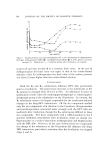
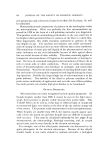
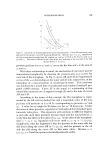
204 JOURNAL OF THE SOCIETY OF COSMETIC CHEMISTS The most effective HLB value is an intermediate one, as illustrated by the pair ot• curves 2-2. This explains the widely recommended practice ot• blending emulsifiers ot• high and low HLB. By doing so, one is as- sured ot• having some emulsifier available to depress (7o/w)• as well as some to elevate T 0. This is the most efficient way to obtain low values of •, whether forming micro or macroemulsions. (Received September 26, 1969) (1) (2) (3) (4) (5) (6) (7) (8) (9) (10) REFERENCES Schulman, J. H., Stoeckenius, W., and Prince, L. M., Mechanism of formation and structure of microcmulsions by electron microscopy, J. Phys. Chem., 63, 1677 (1959). Schulman, J. H., and Montagne, J. B., Formation of microemulsions by amino alkyl alcohols, Ann. N.Y. Acad. Sci., 92, Art. 2, 366-71 (1961). Griffin, W. C., Emulsions, Encyclopedia of Chemical Technology, Vol. 8, 2nd Ed., John Wiley 8c Sons, Inc., New York, 1965, p. 131. Stoeckenius, W., Schulman, J. H., and Prince, L. M., The structure of myelin figures and microemulsions as observed with the electron microscope, Kolloid-Z., 169, 170 (1960). Prince, L. M., A theory of aqueous emulsions, I. Negative interfacial tension at the oil/water interface, J. Colloid Interface Sci., 23, 165 (1967). Bancroft, W. D., Emulsions, J. Phys. Chem. 17, 501 (1913) 19, 275 (1915). Bancroft, W. D., and Tucker, C. W., Emulsions, Ibid., 31, 1680 (1927). Prince, L. M., A thcory of aqueous emulsions, II. Mechanism of film curvature at the oil/water interfacc, ]. Colloid Interface Sci., 29, 216 (1969). Schulman, J. H., and McRoberts, T. S., On the structure of transparent water and oil dispersions (solubilized oils), Trans. Faraday Soc., 42B, 165 (1946). Schick, M. J., Atlas, S. M., and Eirich, F. R., MiceIlar structure of nonionic detergents, J. Phys. Chem., 66, 1326 (1962).
Purchased for the exclusive use of nofirst nolast (unknown)
From: SCC Media Library & Resource Center (library.scconline.org)