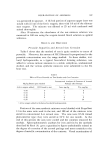
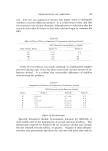
190 JOURNAL OF THE SOCIETY OF COSMETIC CHEMISTS discoloration, were formulated with stable anhydrous alcohol and sub- mitted to the test. In no instance did the test show significantly more in- stability than the original undenatured alcohol. It had been noted, however, that several rejected lots of quassin had tan or brownish colora- tion, and it seemed advisable to check their effect on stability as well as on discoloration of the alcohol. Table V shows that color imparted to alcohol by discolored quassin is not always obvious at a concentration of 0.0113 g per 100 ml, which is equivalent to the government requirement of 1.5 oz per 100 gallons of alcohol. If the color is measured at tenfold the required concentration, the degree of discoloration of alcohol by various lots of quassin becomes more easily apparent. Further data in the table indicate that SDA-40 formulated with discolored quassin shows considerable instability in the test. It is evident that the color quality of the quassin used to formulate SDA-40 is critical on more than one count. Table V Test Results on SDA-40 Formulated with White and Discolored Quassin Lot No. Quassin Denaturant Color in Alcohol Soln., Incremental ASTM Pt-Co Scale HC1 Liberated, Color of mg/kg Based powder visual 0.0113- 0.113- on Alcohol A White 10 20 0.0 B White 10 20 0.3 C Tan 10 30 3.0 D Tan 10 30 12 E Tan 15 60 3.3 "Gratn per 100 tnl alcohol. CONCLUSIONS The measurably greater instability indicated by the test on some com- mercial alcohol samples may derive from presence of minute traces of peroxide impurity. At least, typical peroxide, as known free-radical forming substances, when added to alco.hol induces instability in the test in direct proportion to its concentration. Greater instability in the test forecasted increased metallic contamination of the contents and, there- [ore, corrosion of aerosol cans in a typical accelerated storage test on the unformulated alcohol.

DEGRADATION OF AEROSOLS 191 Results of the test on anhydrous alcohol products do not appear to be affected significantly by moisture content in the range below 0.1%. The denaturants ot• SDA-40 also have no serious influence on the results as long as they are of good quality discolored quassin denaturant induces considerable instability. ACKNOWLEDGEMENT The author wishes to thank E. J. Wickson and M. A. Johnsen for encouragement and advice, and Robert Colley for technical assistance. (Received September 15, 1969) REFERENCES (1) Sanders, P. A., Mechanism of the reaction between trichlorofluoromethanc and ethyl alcohol, Chem. Specialties Mfrs. Assoc., Proc. Mid-Year Meeting, 47 (May, 1960). (2) Reed, A. B., Testing for corrosion of aerosol packages, Ibid., 52 (May, 1966). (3) Bohac, S., Conductomctric testing and corrosion study of nonanhydrous ethanol systems for hair spray, ]. Soc. Cosmetic Chemists, 19, 149 (1968). (4) Root, M. J., Corrosion of aerosol metal containers, Chem. Specialties Mfrs. Assoc., Proc. Ann. Meeting, 42 (Dec., 1955).
Purchased for the exclusive use of nofirst nolast (unknown)
From: SCC Media Library & Resource Center (library.scconline.org)