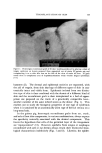
TRANSPLANTATION OF SKIN 115 grafts, or viable suspensions of epidermal cells prepared from tail skin, to the uteri of genetically compatible virgin female rats (12). These grafts were being used as models of Nature's transplants--i.e., blastocysts which implant naturally onto the wall of the uterus and develop into embryos. It was found that if genetically compatible skin grafts--short cylinders of everted tail skin in practice--are inserted into the lumen of the uteri and the hosts are given an intramuscular injection of 50 •g estradiol benzoate to sinrelate the "estrogen surge" necessary for the natural implantation of blastocysts, the grafts rapidly became united to the untraumatized en- dometrial surface and survived indefinitely. In this unnatural site the grafts regenerated sparse fur crops characteristic of tail skin. The epi- thelium of these grafts showed absolutely no tendency to migrate beyond the limits of its own derreal substrate over the adjacent endometrial sur- face. However, in hosts that were treated weekly with estrogen, so. as to maintain a state of chronic estrogen dominance, epidermis began to mi- grate across the endometrial surface, undermining or otherwise displac- ing the native epithelium and becoming firmly united to the underlying uterine mesenchymal stroma. In this way heterotypic epidermal/mesen- chymal reco.mbinant tissue was produced equivalent to that resulting from the grafts described in the previous section. CephMad, migratory activity of the skin epidermis terminated abruptly in the uterus at the uterotubal junction. Gaudad, "tongues" of stratified skin epidermis mi- grated down to and passed through the cervix into the contralateral un- grafted uterine horn, progressively replacing its native epithelium and producing more heterotypic recombinant tissue. On its alien uterine substrate the epidermis of tail skin origin failed to generate any appen- dages, though it did grow down into the uterine glands displacing Ihe native columnar epithelium. When suspensions of epidermal cells were injected into the uteri of estrogen-treated rats, the cells "implanted" on the endometrial surface, generating small loci of epidermal outgrowth. When grafts of tongue mucosa were placed in a rat's uterus, under conditions of estrogen domi- nance, lingual epithelium migrated over the uterine stroma even more vigorously than that of skin, and it also maintained its own specificity. These observations reinforce those obtained by the other procedures de- scribed above, showing that there are intrinsically determined differences between the germinal cells of lingual and trunk epidermis. The capacity of both types of epidermis to replace the native endometrial epithelium towards which they behave as if they enjoy a powerful selective advantage

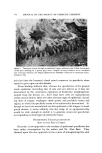
116 JOURNAL OF THE SOCIETY OF COSMETIC CHEMISTS was completely unexpected. We tend to regard muco-cutaneous junc- tions, such as the vermilion border of the lip, and that presenting between the skin and conjunctiva in the eyelid, as fixed and immutable anatomical landmarks. Think how disastrous it would be for us if, as a result of some change in hormonal or vitamin status, epidermal epithelium was able to transgress these natural and biologically important frontiers, re- placing the native type of epithelium with one having entirely different structural and physiological properties. The normal, dermal-epidermal interaction systems so far described have been those producing variant forms of superficial epidermis. Other local forms of this kind of interaction must underlie the morphogenic activity of the germinal cells in epidermal appendages such as hairs and nails. These, too, require special techniques, including grafting, for their analysis. Studies by Cohen (13) and Oliver (14) on the transplanta- tion of follicle components, most conveniently those of vibrissae in rats, have been especially informative. ANALYSIS OF A GENETIC DEFECT IN MOUSE SKIN The procedures described above to study how the specificities of the various epidermal differentia are maintained can also be employed to analyze congenital and other abnormalities affecting' the skin. In the mouse there is a genetically determined form of baldness of early onset (15). The infants develop a normal fur crop but this begins to shed from about the 10th day postpartum. After a few hair growth cycles affected animals become completely bald. The fact that their toenails are long and that adult bald females seem to be incapable of nursing their infants properly hints that the genetic lesion, which is caused by an autosomal recessive gene, hr, affects the entire cutaneous system, including mam- mary glands. This abnormality has been under study by the author in collaboration with Drs. Shaffer and Mann (16). To determine whether the defective hr gene acts systemically, for example by affecting the availability of some metabolite essential for the growth of the hair, or whether it acts locally within the integument required simple grafting experiments (17). It was found that skin from normal mice consistently produces and main- tains a crop o[ normal fur of donor type when transplanted to bald hosts, whereas skin from bald donors conserves its abnormal status when caused to grow on normal mice. Furthermore, when skin grafts are removed from hr/hr fetuses that are destined to shed their fur if allowed to be born and grow up, and are transplanted to normal mice, they develop
Purchased for the exclusive use of nofirst nolast (unknown)
From: SCC Media Library & Resource Center (library.scconline.org)