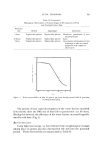
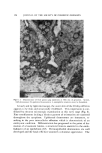
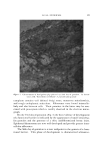
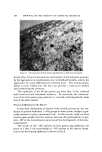
J. Soc. Cosmet. Chem., 22, 119-137 (Feb. 4, 1971) Barrier Development, Ultrastructure, and Sulfhydryl Content of the Fetal Epidermis EDWARD J. SINGER, Ph.D., PAUL C. WEGMANN, B.S., MARJORIE D. LEHMAN, B.S., MICHAEI, S. CHRISTENSEN, B.S., and LEONARD J. VINSON, Ph.D.* Presented May 26-27, 1970, New York City Synopsis--Previous studies have demonstrated that the PERMEABILITY BARRIER of the SKIN resides principally in the stratum comeurn and that in mammalian species this barrier is fully developed at birth. In the present study, development of the stratum comeurn was observed during fetal life of the rat and the guinea pig. Measurements were made of the water permeability of fetal skin at several periods in fetal life through tenn. At the same periods, tissues were examined for changes in fine STRUCTURE and in SULFHYDRYL CONTENT. The data revealed that genesis of the permeability barrier starts in the last quarter of gestation and is concluded just before term. Concurrent with the final stages of formation of the permeability barrier sulfur metabolism is intensified. The horny layer matures as evidenced by increased cellular cohesion and aggregation of tonofilaments into well-defined bundles differentiation of the stratum granulosum and stratum comeurn goes to completion. At birth, the ultrastructure of the stratum comeurn is indistinguishable from that of the adult. INTRODUCTION The skin in the mammal serves two primary "survival" functions, viz., to prevent desiccation of the organism, and to provide a barrier to *Skin studies described in this report were sponsored by U.S. Army Edgewood Arsenal (Contract No. DA 18-108-CML 6573), Edgewood Arsenal, Md. In conducting the research re- ported herein, the investigators adhered to the "Principles of Laboratory Animal Care" as established by the National Society for Medical Research. ? Lever Brothe•'s Co., Research and Development Division, Edgewater, N.J. 07020. 119

120 JOURNAL OF THE SOCIETY OF COSMETIC CHEMISTS entry of foreign materials from the environment, particularly microor- ganisms and noxious substances. It has been confirmed by this labora- tory (1) that these barrier functions of the skin reside principally in the stratum comeurn. It has also been found that this barrier is present in all new-born mammals examined--man, rat, guinea pig. Water diffusion rate was used to evaluate the functional state of the skin barrier in these studies. Data indicate that this is probably the most sensitive measurement of barrier intactness. As an adjunct to these earlier studies, we undertook to study how and when the skin barrier formed in the course of intra-uterine life. In the work to be described, the elaboration of the stratum comeurn during fetal life was studied in the guinea pig and in the rat. Changes in the fine structure and sulfhydryl content of the epidermis were related to the water permeability of the developing skin barrier. The data reveal that genesis of the water barrier starts in the last quarter of gestation, and is concluded just before term. Concurrent with barrier formation, sulfur metabolism is intensified and the horny layer matures. MATERIALS AND METHODS Animals Guinea pig fetuses were obtained from females of the Lever colony, which was originally derived from Lederie and Deeroff stock. The day of fetal life was estimated by control on mating activity and by compari- son with photographs of fetuses of known age (2). More precise estimates were made on the assumption that crown-rump length increases ex- ponentially with time during the expected gestation period of 63 days. This assumption is supported by growth data for the rat (3) and mouse (4). Rat fetuses were t•rovided by females obtained from Hemlock Hol- low Farms. The extreme fragility exhibited by the skin of fetal rats earlier than the 18th day of gestation precluded studying the early stages of barrier formation in this species. The guinea pig fetus, on the other hand, provided skin that could be handled and assessed for barrier prop- erties over a large part of the gestation period. Permeability Measurements The in vitro water permeability of fetal skin was determined accord- ing to a gravimetric procedure originally described by Burch and Winsor (5). The skins were mounted on microdiffusion cells (area = 0.78 cm=,
Purchased for the exclusive use of nofirst nolast (unknown)
From: SCC Media Library & Resource Center (library.scconline.org)