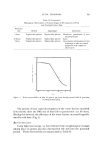
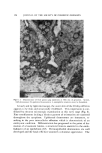
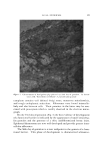
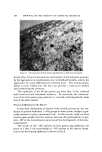
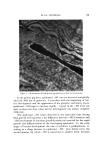
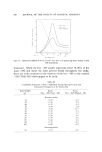
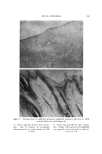
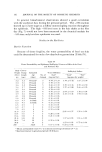
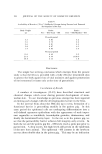
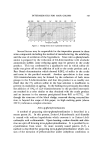
INTERMEDIATES FOR HAIR COLORS 149 The infrared spectrogram of the sludge from 2-amino-5-nitrophenol differs in so many ways from that of the pure or crude product that there can be no doubt that it is an entirely different compound. However, insufficient data are available to warrant any speculation as to its struc- ture. The amount of material precipitated in the boiling experiment, pre- viously described, was 0.10% for the crude and 0.02% for the purified 2-amino-5-nitrophenol. 2-A mino-4-nitrophenol 2-Amino-4-nitrophenol can be prepared by the reduction of 2,4-dini- trophenol with sodium sulfide, followed by neutralization and crystalliza- tion from water (11). Its solubility at 25øC in aqueous solution at a pH of 9.7 is $.47% (1). Comparable analyses of this intermediate before and after recrystallization, as a production lot, are given in Table V. Unlike the other nitro intermediates considered in this paper, this compound forms a hydrate. The water can be removed by a prolonged drying at 65øC. Table V Analyses of 2-Amino-4-nitrophenol Purified Raw Purity, % 97.9 75.0 Ash, % 0.07 0.06 Iron, ppm 69 230 Melting point (Fisher-Johns), øC 145.7 . . . Melting point of hydrate, øC 110.0 93.0 Water, % . . . 11.6 In the ageing tests, precipitation of the solution containing the crude product started after 15 days both at 50øC and at room temperature, while no precipitate appeared in bottles containing the purified material after 4 weeks. The infrared spectrograms of the crude and purified 2-amino-4-nitrophenol showed no significant differences. During the recrystallization of 2-amino-4-nitrophenol from water, it .gave off an odor similar to that of exploded firecrackers. The infrared spectrogram of this sludge showed no relationship to those of the crude or purified products. It was found to be insoluble in all the organic sol- vents tested and no significant bands appeared in the in[Tared spectro- gTam, indicating that it is most likely a product formed by decomposi-

150 .JOURNAL OF THE SOCIETY OF COSMETIC CHEMISTS tion. This sludge melted at 137øC. It had an ash content of 1.42% and contained 0.58% iron determined and reported as ferric oxide. The amount of material precipitated in the boiling experiment pre- viously described was 0.60% for the crude 2-amino-4-nitrophenol and 0.30% for the purified. Effect of Iron Content on Precipitation Since the iron content of the raw products was, in most cases, sub- stantially higher than that of the recrystallized materials, it seemed possi- ble that this might be a factor in the precipitation. Because of the fact that, in the tests described, precipitation occurred more rapidly from a solution of crude nitro-o-phenylenediamine than from the other crude products, purified nitro-o-phenylenediamine was selected for this experi- ment. One liter each of six base solutions containing 1 g of purified nitro-o-phenylenediamine was prepared with a portion of the water re- placed with a solution containing ferrous sulfate. The iron content of each base solution was: Sample 1 2 3 4 5 6 Iron added, ppm 0 200 400 1000 4000 10,000 No precipitation was obtained with any sample after ageing for 4 weeks, indicating that iron is probably not responsible for precipitation on ageing. CONCLUSION Even though the so-called crude nitro-o-phenylenediamine, nitro-p- phenylenediamine, 4-amino-2-nitrophenol, 2-amino-5-nitrophenol, and 2-amino-4-nitrophenols considered in this paper are relatively pure, they all cause precipitation in oxidation hair dye base solutions on ageing. Since in all cases the base solutions are clear at the time of preparation, and since the time required for precipitation varies from 1 to 15 days, depending on which of these compounds is used, the problem cannot be solved by a simple filtration following the preparation of the base solu- tions. It has been determined that, in all cases, a recrystallization process was effective in removing the materials present in the crude products that were responsible for this precipitation. In fact, base solutions prepared in this laboratory, using purified dyes, showed no precipitation on ageing at reom temperature for 30 months.
Purchased for the exclusive use of nofirst nolast (unknown)
From: SCC Media Library & Resource Center (library.scconline.org)