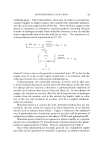
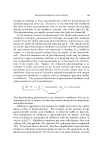
PHOTOCHEMICAL REACTIONS 89 though no binding to these macromolecules could be demonstrated by methods indicated above (2). However, it was observed that ribofiavin did bind to these macromolecules and to micellar sodium decyl sulfate during irradiation of the ribofiavin solution with visible light (2, 16). This photobinding was rapidly reversed when the light was turned off. In the absence ot/external reducing agent, the isoalloxazine nucleus of ribofiavin undergoes photoreduction through intramolecular hydrogen transfer from the ribityl side chain and it therefore is unnecessary to com- plicate the system by adding external reducing agent. The enhanced rate of aerobic photobleaching of ribofiavin in presence of PVP, polysorbate 80, and sodium decyl sulfate was attributed to binding of a ribofiavin triplet, or a reactive species arising from the triplet, to the macromole- cule. Since the enhanced rate of photobleaching could only be demon- strated in oxygen-containing solutions, it is proposed that the enhanced rate of photobleaching is not attributable to an increased rate of forma- tion of the triplet state. Rather, the enhanced photobleaching is at- tributed to either protection of the bound excited state from oxygen quenching, with an increased lifetime for the reactive triplet state, or to inhibition of the reaction of a partially reduced intermediate with oxygen to regenerate ribofiavin or a species with an absorption spectrum similar to ribofiavin. The proposed interaction of photoexcited ribofiavin with a macromolecule can be represented as: R • R* • R' 4- macromolecule products R'-- macromolecule The photobinding phenomenon is not limited to ribofiavin, but can be demonstrated for a number of other dyes and for drugs such as menadione and hydrocortisone. Binding to appropriate macromolecules might also lead to the stabili- zation of dyes to photoreduction. For example, in the presence of the polynucleotide nucleic acid, ribofiavin is relatively stable to light (2). The stabilization of ribofiavin to photoreduction by nucleic acid has been attributed to interaction of ribofiavin with the adenine moiety of nucleic acid (17). Ribofiavin complexes not only with adenine, but with caffeine (18), theophylline (18), phenols (19), and many other compounds (20). It has been shown, however, that the complexation of gTound state ribofiavin with these molecules cannot account for the magnitude of the fluorescence quenching (18, 19), nor for the even more dramatic increase

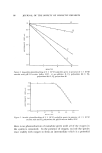
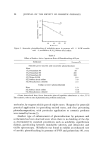
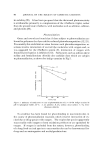
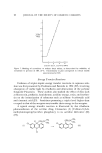
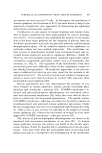
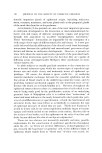
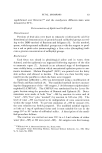
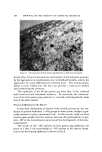
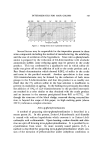
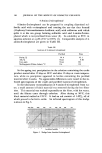
90 JOURNAL OF THE SOCIETY OF COSMETIC CHEMISTS in stability (20). It has been proposed that the decreased photoreactivity is attributable primarily to complexation of the riboflavin triplet, rather than the ground state riboflavin, with molecules such as adenthe, caffeine, and phenols (20). Photooxidation Oster and coworkers found that if dyes subject to photooxidation are bound to polymers the dyes exhibit reduced photodecomposition (12, 21). Presumably this stabilization arises because such photodecomposition re- actions involve interaction of excited dye molecules with oxygen and, as was suggested for the ribofiavin system (2), interaction of oxygen with bound excited species is inhibited (12). Surfactants such as sodium decyl sulfate and benzalkonium chloride also stabilize dyes which are subject to photooxidation, as shown for indigo carmine in Fig 5. ø'4••C 0.40 0.55 50 6 90 120 MINUTES Figure 5. Influence of surfactants on rate of photooxidation of 2 X 10-SM indigo carmine in pH 7.4 phosphate buffer, 25øC. A, no additive B, 2% sodium decyl sulfate C, 5% benz- alkonium chloride No evidence has been found for photobinding to macro•nolecules in the course of photooxidation reactions which involve interaction of ex- cited dye or drug species with oxygen. The triplet dye species apparently react readily with oxygen to form oxidation products or are quenched by oxygen. If oxygen is excluded from the system, however, photobinding of a long-lived excited species to macromolecules can be demonstrated for drugs such as aminopyrine and methylprednisolone.
Purchased for the exclusive use of nofirst nolast (unknown)
From: SCC Media Library & Resource Center (library.scconline.org)