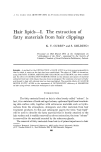
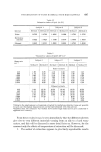
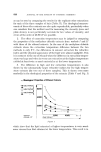
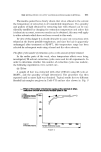
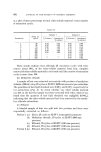
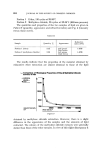
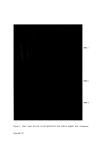
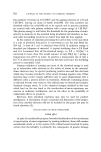
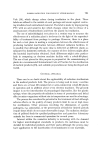
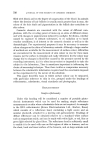
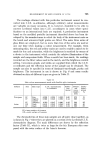
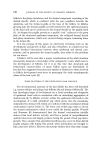
TI-IE EXTRACTION OF FATTY MATERIALS FROM HAIR CLIPPINGS The results quoted have clearly shown that when ethanol is the solvent the temperature of extraction is of considerable importance. The qunatity and quality of lipid obtained by extracting hair with ethanol can be con- siderably modified by changing the extraction temperature and unless this is taken into account, erroneous results can be obtained this may well apply to other solvents which have not been covered in this work. In view of this danger it is clearly desirable to carry out extractions with ethanol at the lowest possible temperature, and since the hair is apparently undamaged after treatment at 32-35øC, this temperature range has been selected for subsequent work using ethanol and the other solvents. The effect of the number of extraction cycles on the amount of lipid removed In the earlier parts of the work, when temperature effects were being investigated, 25 solvent extraction cycles were used for all experiments. In order to determine whether this number of extraction cycles was realistic, the following experiments were carried out:- (a) Ether A sample of hair was extracted with ether (150 ml) using 25 cycles at 32-35øC, and the quantity of lipid determined. The procedure was then repeated until no more lipid was obtained. Typical results for two different blended hair samples are given in Table VII and are also shown in Fig. $ Effect of the number of extraction cycles on the removal of ether, methylene chloride and alcohol-solu'ble lipids of hair. o ether • methylene chloride [] ethanol yoage of extractable material 75 50 25 25 50 75 100 125 Number of extraction cycles Figure

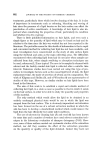
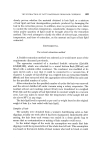
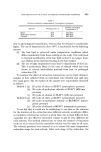
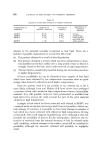
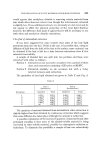
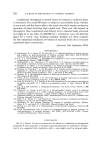
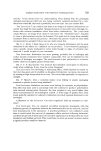
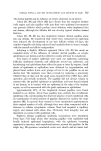
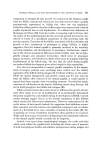
692 JOURNAL OF THE SOCIETY OF COSMETIC CHEMISTS as a plot of mean percentage of total ether-soluble material versus number of extraction cycles. Extraction Table VII Total no. cycles 25 5O 75 100 125 150 175 200 225 Subject 1 Extract i Cumulative % extract 3.72 3.72 0.62 4.34 0.26 4.60 0.15 4.75 0.08 4.83 0.00 4.83 Sub • Extract 5.60 0.33 0.26 0.41 0.02 0.09 0.07 0.02 0.02 ect 2 Cumulative •o extract 5.60 5.93 6.19 6.60 6.62 6.71 6.78 6.80 6.82 These results indicate that although 25 extraction cycles with ether remove about 80% of the ether-soluble material from hair, complete removal of ether-soluble material is not found until the number of extraction cycles is more than 100. (b) Methylene chloride A sample of hair was extracted successively with portions of methylene chloride (150 ml) using 25 cycles at 32-35øC (600 mm pressure) per extraction. The quantities of hair lipid obtained were 3.28% and 0.12% respectively for two extractions (Fig. 3). To check whether any ether soluble material was left on the hair the sample •vas then extracted with ether, when it was found that the quantity of hair lipid obtained was negligible (0.04%), indicating that the ether-soluble material had been removed by the methy- lene chloride extractions. (c) Ethanol A blended sample of hair was split into two portions and these were sequentially extracted as follows:- Portion 1 (a) (b) (c) (d) Portion 2 (a) Ether, 25 cycles at 32-35øC (atmospheric pressure) Methylene chloride, 25 cycles at 32-35øC (600 mm pressure) Ethanol, 25 cycles at 32-35øC (100 mm pressure) Ethanol, 25 cycles at 32-35øC (100 mm pressure) Ethanol, 25 cycles at 32-35øC (100 mm pressure)
Purchased for the exclusive use of nofirst nolast (unknown)
From: SCC Media Library & Resource Center (library.scconline.org)