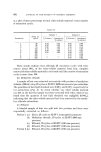
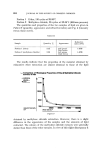
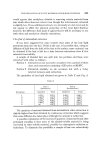
GUINEA-PIG HAIR FOLLICLE FOR EXPERIMENTAL OBSERVATION 709 occur in groups of three. It is of particular interest that although the periodicity of follicles varies from region to region, follicles within each triad are synchronized with each other. In view of the fact that different types of fibre occur in the guinea-pig, is it possible that there are different types of human hair follicle? DR. JACKSON: I believe that this is quite possible. Perhaps I can best illustrate this by referring to sonhe other work which we have carried out on wonhen of different ages, and in which those with normal heads of hair were compared with those showing sonhe diffuse thinning of their hair on the vertex. The results indicated that in normal women the greatest incidence of hairs are those with a diameter of about 0.08mm. How- ever, during diffuse thinning the diameter decreases, and it seems to produce two differ- ent peaks and thereby possibly reveal two different types of hair, one with a diameter of 0.04 mm and one with a diameter of 0.06mm. Other work carried out on human males has invariably been based on dividing the hairs, more for convenience than anything else, into three groups--thin, intermediate and thick--and we wonder therefore if these results possibly show these three different types in the fenhale. In our case the 0.04mm peak would represent the thinnest hairs, the 0.06mm peak the intermediate hairs, and the 0.08mm peak the thickest hairs present in the scalp. This is perhaps indirect evidence of different types of hair in the scalp. The main difficulty that one encoun- ters in trying to substantiate this, however, is that the duration of follicular activity in the human scalp is of the order of two to three years, compared with 25-40 days in the guinea-pig. Hence it is difficult to find complete human hairs, and make detailed comparisons between them to determine if there are different fibre types. MR. J. M. BLAKEWAY: The duration of the experiment here was only 48 days, which is insufficient, I would imagine, to cover the anagen phase completely. From Fig. 1, the hairs must be 3 or 4cm long. If the hairs grow an average 0.Smm day-1 for 48 days their length will only be about 2.5cm, whereas the type 1 hairs in par- ticular are much longer than that. In other words, the complete growth rate curve presumably goes right back nearly to zero before the hair is finally moulted. DR. JACKSON: Yes, the final length of the type 2 hairs, which we looked at in Fig. 8, is about 15mm, and our experimental observations were only continued long enough to allow the production of complete hairs of this one type. I cannot detect a lower rate of growth than about 0.2 mm day-l, and I suspect that this is the initial rate of growth of this particular type of hair. We have, incidentally, found from other data that the duration of anagen of the type 1 hairs is about 40-44 days when, being a longer and a thicker hair, the rate of growth is also higher. The maximum rate of growth is of the order of 0.7 mm day-•, compared with 0.6 mm day-• for the type 2 hairs. It is of sonhe interest that the final length of the hairs of the guinea-pig and the rat is of the sanhe order, but the way in which the follicles produce the hairs is quite different. In the rat the hairs grow faster, but for a much shorter period of time than the hairs of the guinea-pig. Nevertheless, the hairs produced are of a similar length.

j. Soc. Cosmet. Chem. 22 711-723 (1971) ¸ 1971 Society of Cosmetic Chemists of Great Britain Gamma radiation for product sterilization F. J. LEY, Presented on 18th November 1970 in Bournemouth, Hants. at the Symposium on "Cleansing" organised by the Society 9f Cosmetic Chemists of Great Britain. Synopsis--The high penetrating power of GAMMA RADIATION makes it particularly suitable for the STERILIZATION of products in their final pack. The choice of radiation DOSE will depend on the number and types of CONTAMINANTS involved and on the influence of the environment on their radiation RESISTANCE. Radiation may have an adverse effect on some materials and products and these should be tested individually. The operation of radi.•tion planls is briefly d•scribed with emphasis on the methods of PROCESS CONTROL. INTRODUCTION It is just over 10 years since gamma radiation sterilization was introduced in the U.K. for the treatment of commercial products. The source of the radiation is the radioisotope cobalt-60 familiar through its use in medicine in the field of tumour therapy and it is the same properties of the emitted gamma rays. i.e. high penetrating power and lethal effect on living cells, which are used to advantage in sterilization. The rapid development of nuclear power has given the capacity to produce sufficient quantities of cobalt-60 for use in industrial radiation plants in which high radiation doses are required for the treatment of large volumes of material. Apart from its ease of production in reactors by bombardment of the inactive cobalt-59 with neutrons, cobalt-60 has a suitably long half-life of 5.3 years. Each disintegration of cobalt-60 involves the emission of a *Irradiated Products Ltd., Denchworth Road, Wantage, Berks. 711
Purchased for the exclusive use of nofirst nolast (unknown)
From: SCC Media Library & Resource Center (library.scconline.org)