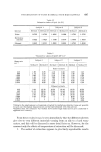
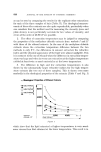
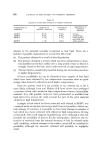
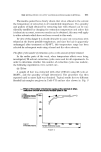
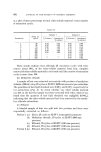
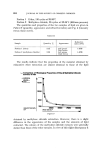
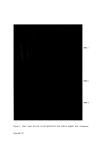
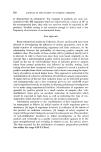
THE EXTRACTION OF FATTY MATERIALS FROM HAIR CLIPPINGS 695 would appear that methylene chloride is removing certain material from hair which ether does not extract even though the total amount extracted is slightly less. These additional extracts are obviously at a low level and do not appear to affect the physical properties of the total lipid fraction however, the difference does make it appear that it will be necessary to use both ether and methylene chloride extractions. The effect of intermittent extraction It has been suggested by some workers that some of the hair lipid penetrates deep into the hair. If this is the case, it is possible that, owing to diffusion of lipid from the bulk of the hair to the surface, more material can be obtained if the hair is left for a time between extractions than if it is extracted successfully. A sample of blended hair was split into two portions and these were extracted with ether as follows:- Portion 1 Extracted on six successive occasions over a period of three days, each extraction consisting of 25 cycles at 32-35øC. Portion 2 Extracted similarly on six occasions but with a 7-day interval between each extraction. The quantities of hair lipid obtained are given in Table X and Fig. $. Table X Extraction 1 2 3 4 5 6 , Part 1 (Successive) Quantity 3.72% 0.62% 0.26% 0.•5% o.os% nil Total 3.72% 4.34% 4.60% 4.75% 4.83% 4.83% Part 2 (Intermittent) Quantity 3.ss% 0.44% 0.34% 0.34% o,o6% Total 3.53% 4.02% 4.36% 4.so% $.o•% 5.07 % The quantity of material obtained from intermittent ether extraction is slightly higher than that obtained by continuous extraction which suggests that some diffusion has taken place although the amount is rather low. A possible explanation of the increased quantity of material found after prolonged standing is that some of the alcohol-soluble material is being converted to ether-soluble material, possibly by atmospheric oxidation or hydrolysis. To eliminate this possibility a sample of hair was exhaustively

696 JOURNAL OF THE SOCIETY OF COSMETIC CHEMISTS ,, •. Comp. arison of the effect of interrnitent and successive extraction of h•ir with ether. interrr•tent extraction successive extraction ø•ether-soluble lipid 6 4 2 25 50 7• 100 1'•5 1•0 I number of extraction cycles Figure extracted with ether and this was followed by extractions with methylene chloride and ethanol until no further lipid materials were obtained. The hair sample was then stored in a desiccator for one week and then re-extracted with ether, when a further 0.1% by weight of fatty material was obtained. The hair sample was stored for a further week and again re-extracted, when a further 0.08% of fatty material was obtained. These results indicated that the extra lipid could not have been obtained by conversion of the ethanol- soluble matehal and it would appear that the diffusion suggestion may be valid. However, an alternative explanation to that of diffusion of fatty matedhals from inside the hair can be put forward to account for these additional small quantities of extractable material. The surface of hair contains a number of free acid groups and these can react with calcium or magnesium ions present in tap water which comes into contact with the hair. Both these ions are di-valent and can act as bridging atoms to bind free fatty acids present in hair lipid to the surface of the hair. If this is so, then we can explain the additional matedhals obtained as being due to the hydrolysis of some of these tightly bound fatty acids. To investigate this idea further, the following experiment was carried out. A sample of hair was exhaustively extracted with ethel, methylene chloride and ethanol and then the hair was placed in cold 0.1 N hydro- chloric acid (150 ml) for 2 h. The sample was then washed thoroughly
Purchased for the exclusive use of nofirst nolast (unknown)
From: SCC Media Library & Resource Center (library.scconline.org)