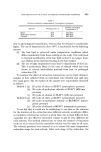
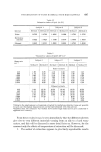
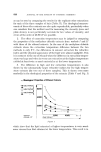
THE EXTRACTION OF FATTY MATERIALS FROM HAIR CLIPPINGS 693 (b) Ethanol, 25 cycles at 32-35øC (100 mm pressure) (c) Ethanol, 25 cycles at 32-35øC (100 mm pressure) (d) Ethanol, 25 cycles at 32-35øC (100 mm pressure) The quantities of the materials obtained using the two extraction pro- cesses are shown in Table VIII the extraction with ethanol only is com- pared with the extractions with ether and methylene chloride in Fig. 3. Table VIII Extraction procedure (a) (b) (c) (d) Portion 1 Extract 2.67 1.05 0.67 0.03 Cumulative % extract 2.67 3.72 4.39 4.42 Portion 2 Extract 3.18 1.06 0.09 0.09 Cumulative •o extract 3.18 4.44 4.53 4.58 The results in Table VIII and Fig. 3 indicate that if ethanol alone is used (portion 2) then some 75 cycles are required for removal of the hair lipid whilst if it is used after ether and methylene chloride (portion 1) then only 25 cycles are required. This suggests that the best order of use of solvents (from the point of view of time and convenience) would be ether, followed by methylene chloride and then ethanol. (In our experimental procedure it was found that ether extraction took about 2-3 mins cycle -• methylene chloride extraction 4 mins cycle -•, and ethanol extraction 12-15 mins cycle -• Equivalence of ether and methylene chloride extracts The results given previously indicate that after extraction of hair with methylene chloride there is little if any ether-soluble material left. In addition, if a sample of hair is extracted with ether for 150 cycles and then extracted with methylene chloride, no lipid is obtained. This suggests that the 20% of ether-soluble material left on hair after 25 extraction cycles with ether (Fig. 3) is methylene chloride-soluble material. If this is so, then it is reasonable to expect that the material removed by say 100 cycles with ether is very similar to that removed by 25 cycles with methylene chloride. To examine this point the following experiment was carried out: A blended sample of hair was split into two portions and these extracted as follows:-

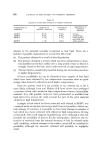
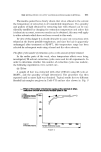
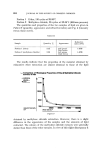
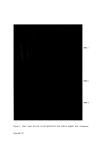
694 JOURNAL OF THE SOCIETY OF COSMETIC CHEMISTS Portion 1 Ether, 110 cycles at 32-35øC Portion 2 Methylene chloride, 25 cycles at 32-35øC (600 mm pressure) The quantities and properties of the two samples of lipid are given in Table IX (quantity, appearance and refractive index) and Fig. 4 (viscosity versus shear curve). Table IX Sample Portion 1 (ether) Portion 2 (methylene chloride) Quantity 2.22 2.09 Appearance Soft grease Pale brown Soft grease Dark brown Refractive index (17øC) 1.4725 1.4728 The results indicate that the properties of the material obtained by exhaustive ether extraction are almost identical to those of the lipid r g4. ComparJsorl of Rheological Properties of Ether& Methylene Chloride extracts of hair, 0 methylene cl'•oride ß ether 5OO apparent viscosity 7500 1 c.R shear rate sec Figure obtained by methylene chloride extraction. However, there is a slight difference in the appearance of the samples and the amounts of lipid extracted. The colours of the methylene chloride extracts were generally darker than those of the ether extracts. In view of this slight discrepancy it
Purchased for the exclusive use of nofirst nolast (unknown)
From: SCC Media Library & Resource Center (library.scconline.org)