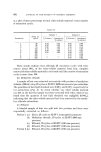
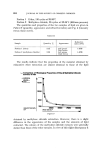
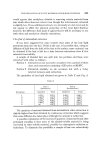
THE EXTRACTION OF FATTY MATERIALS FROM HAIR CLIPPINGS 699 and magnesium stearates are formed from the interaction of calcium and magnesium ions from the water, with free fatty acids in the sebum during the washing and rinsing stages. Even if shampoos removed all hair lipid from hair, and we knoxv they do not, there would still be a residue of calcium and magnesium salts on the hair after drying which would react with freshly generated hair lipid. As a result, and since almost all methods of assessing shampoo detergency are based on solvent extraction techniques, it follows that large errors can be made in estimating detergency efficiency depending on the pH of the wash solutions and the hardness of the water. A shampoo with an acid pH can liberate "extra" fatty acid, whilst washing in hard water can insolubilise fatty acid not removed by the shampoo. This is a separate phenomena to the well known adverse effects of calcium and magnesium ions on detergents. MR. M. G. OENAVARRE: That is very interesting. Do you not consider that this is actually fat that is tied into the keratin molecule as a lipoprotein? MR. CURRY: Some of the material present in the initial high temperature extracted alcohol-soluble fractions described earlier is undoubtedly intracellular material such as phospho-lipids, lipoproteins, etc. However, after the hair has been exhaustively extracted with alcohol, methylene chloride and ether and allowed to stand for several days, a further amount of ether soluble material is extractable. I believe that this material is free fatty acid from calcium and magnesium stearates on the surface of the hair which are slowly hydrolysing.

j. Soc. Cosmet. Chem. 20. 701-709 (1971) ¸ 1971 Society ooe Cosmetic Chemists ooe Great Britain The guinea-pig hair follicle as an object for experimental observation D. JACKSON* and F.J. EBLINGt Presented on loth March 1971 at the Symposium on "Appendages of the Skin", organised by the Society of Cosmetic Chemists of Great Britain in Eastbourne, Sussex. ltlti10p$15--It is often suggested that the GUINEA-PIG might be more suitable for EXPERI- MENTS on HAIR GROWTH than rats or mice because it resembles the human scalp in that each hair FOLLICLE undergoes a cycle of activity which is independent of its neighbours. Studies in which growing hairs were pulse labelled by daily injections of 35S-cystine showed that, for at least 50 days after birth, follicles producing a single fibre type are in synchrony with each other, but out of phase with those producing different types. The growth rate of each hair is not constant. It gradually increases to a maximum rate which is maintained for five or six days before gradually falling towards the 'end .of follicle activity. It is essential therefore that the hair follicle types are identified in any such study, and that when rates of growth are to be compared, they must be based on the whole of the period of ANAGEN, or, if not, on comparable parts of it. Finally, the results emphasize that in any studies on hair growth it is important to know the AGE of the animals, and to match controls of the same age to each experimental animal. The formation of hair by individual follicles is intermittent in all species so far studied, except the Merino sheep (1). The hair follicle under- goes cycles, each consisting of an active period or anagen (2), a transition phase or catagen, and a resting period or telogen when the hairis retained as a 'club'. During anagen, the club hair produced during the previous cycle is usually lost, i.e. moulted. In many mammals, the process of hair replace- ment and subsequent moulting takes place in a patterned sequence over the body. For example, in the mouse and in the rat (2-9) moults start on the belly and move over the flanks towards the back, subsequently moving towards the head and the tail. Since only a small area of the skin is in *Now at Department of Anatomy, The University of St. Andrews, Fife, Scotland. ]'Department of Zoology, The University, Sheffield, SI0 2TN. 701
Purchased for the exclusive use of nofirst nolast (unknown)
From: SCC Media Library & Resource Center (library.scconline.org)