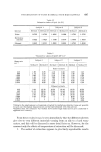
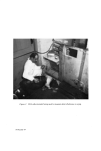
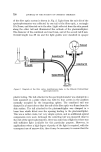
THE EXTRACTION OF FATTY MATERIALS FROM HAIR CLIPPINGS {383 clearly proven whether the material obtained is hair lipid or a mixture of hair lipid and hair decomposition products produced by damaging the hair in the extraction process. In addition, since no precautions were taken to control the extraction temperature, considerable changes in the compo- sition and/or quantity of lipid could be brought about by the extraction method. This work attempts to clarify the effect of solvent type, extraction temperature, and time of extraction, on the amount and type of hair lipid extracted. EXPERIMENTAL The solvent extraction method A Soxhlet extraction method was selected as it would meet most of the requirements discussed previously. The apparatus consisted of a standard Soxhlet extractor (Quickfit EX$/133/100), which was attached to a round bottom flask (250 ml) and fitted with a suitable reflux condenser. The condenser was modified at its open end in such a way that it could be connected to a vacuum line, if required. A sample of hair (5-10 g) was weighed into an extraction thimble (t30 ml) and then extracted with the appropriate solvent (150 ml in each case) for the specified number of cycles. After extraction for the specified number of cycles the hair was removed and the solvent distilled off under vacuum using a rotary evaporator. The residual solvent and washings (about 10 ml) were transferred to a weighed Petri dish and the sample of hair lipid dried to constant weight in a vacuum oven. Care was taken to ensure that the temperature of the sample did not rise above 35 øC at any stage. The hair lipid level is reported as per cent by weight based on the original weight of hair (i.e. hair soiled with hair lipid). Samples of hair The samples were obtained from a women's hairdressing salon as hair clippings, usually one week after it had been shampooed. Immediately after cutting, the hair from each •voman was sealed in a clean plastic bag to ensure that no contamination or mixing of hair samples could occur. In the initial stages of the work the assumption was made that hair clippings would be representative of the whole head of hair. This assumption was based on the known habits of most women who tend to brush or comb

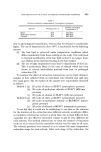
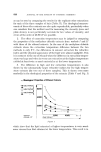
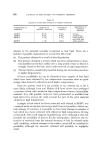
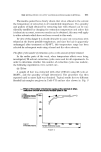
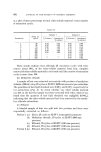
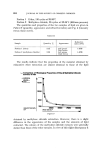
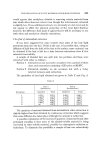
684 JOURNAL OF THE SOCIETY OF COSMETIC CHEMISTS their hair on numerous occasions throughout the week. This would tend to spread the hair lipid in an even layer along the whole length of the hair. Once the method of extraction had been developed sufficiently an experiment was carried out to verify this assumption. An unwashed switch of hair (some 14 in. long) which had been cut off at about two inches from the scalp was obtained. The switch was cut into two inch lengths and the hair lipid content of each length was determined. The values obtained were identical within experimental error in all cases indicating that it did not matter whether hair samples were collected near the root or the tip of the hair. The selection of the solvents It is common practice when extracting lipids, to employ a sequence of solvents of varying polarity, generally starting with the least polar solvent that will usually extract the bulk of the solvent soluble material. The most commonly used solvents for such extractions are pentane (petroleum ether), diethyl ether, ethanol and chlorinated hydrocarbons. In the present case, however, sufficient is known about the composition of the lipid matehal to be extracted (11, 12) to eliminate pentane because it is unlikely to give a complete extraction, and diethyl ether, methylene chloride and alcohol, which have polarities of 1.1, 1.5 and 1.8 Debye, were chosen as a range of likely solvents. Diethyl ether was selected as the first and principal solvent partly because of its previous use in extracting skin lipids and its very low boiling point. Methylene chloride was chosen as the second solvent, again because of its low boiling point and also since it was intermediate in polarity between ether and alcohol. Ethanol was selected as a final solvent based on the expectancy that it would remove more polar matehals from the hair. In addition these solvents also give a range of boiling points from 35-78øC, so they would enable the effect of temperature to be examined. Effect of temperature In a Soxhlet extraction the temperature range experienced by a sample depends on a number of interdependent factors including the boiling point and latent heat of the solvent, the quantity of the solvent to be heated and the heating capacity of the apparatus used. Table I gives the boiling points of the solvents used and the effective extraction temperatures attained in our apparatus. As can be seen the extraction temperatures are close to the boiling points of the respective solvents. The extraction temperatures for ether and methylene chloride are very
Purchased for the exclusive use of nofirst nolast (unknown)
From: SCC Media Library & Resource Center (library.scconline.org)