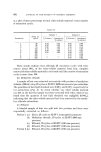
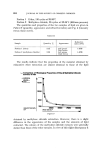
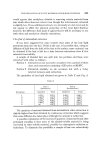
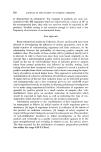
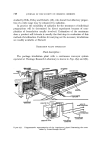
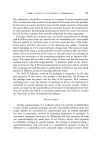
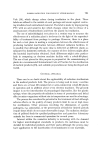
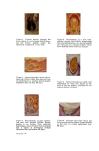
DERMAL PAPILLA AND THE DEVELOPMENT AND GROWTH OF HAIR 749 with a central core of papillary tissue containing capillaries. Here the inner aspect of the epithelium was ridged and thick squamous keratin was being produced. Alternatively, associated with smaller papillary indentations, there was the localized development of large fibrous cells, resembling cortex cells in the keratogenous zone of hair follicles, which were producing spikes of keratin, as opposed to squames, histologically identical to the alpha- keratin of hair. There were also instances of epithelium present as a stellate reticulum reminiscent of the enamel organ of developing teeth (Fig. $). Several small hair folhcles were found as were, in other regions, sebaceous cells sometimes associated with the locahzed development of a granular layer. Otherwise a large, very short, bulb-like configuration was seen with lateral outer and inner root sheaths whose matrix was producing large, loosely associated cortex-like cells containing wispy keratin fibres (Fig. 6). There was also a large follicular structure with follicle sheaths but, instead of differentiating hair elements, the papilla was capped by a stellate reti- culum configuration. Finally, incorporated into one side of a papilla/epi- thelial complex, was a small aberrant follicle with the usual follicular features on the ear dermis side, which was producing a spike of keratin via large fibrous cells as described for the small type of projection above. DISCUSSION The derreal papilla and follicle development The prospective dermal papilla is established as a permanent and stable population of cells very early in the ontogenetic development of the hair follicle, appearing as an aggregation of cells at or before the first histological signs of change in the epidermis. There is evidence that a crucial interaction occurs at this time fixing the site of follicle development (15). After this interaction occurs the epidermal component presumably also has an active developmental role since in certain circumstances it can initiate the develop- ment of new papillae (17, 18, 23). As follicle development proceeds a second vital interactive stage is reached which is essential to ensure hair growth (15). The factors responsible for establishing dermal papillae as specialized variants of the dermis are unknown. Presumably they arise as a consequence of other sub- and intradermal events related, perhaps, to the timing and pattern of development of the peripheral neural and vascular systems (43, 44). Whatever the reason, it is known that follicles can develop in vitro in embryonic skin explanted days before follicle histogenesis such explants

750 JOURNAL OF THE SOCIETY OF COSMETIC CHEMISTS also contain the necessary information for determining whether whiskers or pelage hairs will develop (4). The adult whisker dermal papilla also has a profound effect on adult epidermal cells, locally promoting the development of an increased and highly mitotically active germinal population, including suprabasal mitoses, associated with a columnar basal layer. This seems to be the prelude to many epithelial developmental situations (e.g. Wessells (45)). Indeed the papilla may then go on to induce the formation of hair follicles, regardless of whether the epidermis contained epidermal follicular elements or had no previous history of being follicular epidermis. None of these follicles was typical of the site of origin of the epidermis or, indeed, of the implant site. Rather they more closely resembled small whisker follicles, although lacking the usual whisker dermal features. Two further observations merit consideration. Not all papilla/epidermal associations formed functioning hair follicles. Even where they were formed development proceeded slowly. Straile (46) believes that the neuro- vascular contribution to hair follicles, as inferred from histological studies of the tylotrich follicle, may be vitally involved in hair growth. It is there- fore conceivable that the associated development, or not, of this ill-under- stood component was a limiting factor in the present induction studies. It may be relevant that while in vitro cultures of embryonic skin develop follicles and grow a short length of hair, continued hair growth has not been achieved (47). Of great interest was the influence of whisker dermal papilla on oral epithelium. Available evidence has suggested that the specific pattern of keratinization of this epithelium, like feather epidermis, is innately deter- mined so that it is genetically incapable of being modulated by contrary dermal influence. However, instances of attempts, some more or less success- ful, at follicle formation in the presence of papilla cells are highly indicative that provided the dermal influence is strong enough oral epithelium is also capable of modulatory behaviour. Just as intriguing, and reinforcing the above interpretation, was the development of stellate reticula, histologically highly reminiscent of the enamel organ of developing teeth. Here again an unblocked but previously repressed genetic potential seems to have re- vealed by some stimulatory effect, presumably non-specific, of the papilla cells. The derreal papilla, the hair cycle and the hair The continuing presence of the dermal papilla adjacent to the epidermal
Purchased for the exclusive use of nofirst nolast (unknown)
From: SCC Media Library & Resource Center (library.scconline.org)