J. Soc. Cosmet. Chem., 23, 77-87 (February 3, 1972) Pearlescence: The Optical Behavior of "White" Nacreous Pigments as an Interference Effect R. A. BOLOMEY, Ph.D., and L. M. GREENSTEIN, Ph.D.* Presented May 24-25, 1971, Seminar, Washington, D.C. Synopsis--Titanium dioxide-coated mica is a NACREOUS (PEARLESCENT) PIGMENT which may reflect either white or colored light, depending on the thickness of the TiO• layer. The colors are produced by INTERFERENCE. The TiO,layers of "WHITE" pearl pig- ments are thinner than those of colored pigments. Theoretical spectrophotometric reflectance curves were computed for interference fihns too thin to produce interference color. Reflectance values at vari,ous wavelengths were calculated from a form of the general Fresnel formulas for reflection of light by a thin film. Fihns with optical thicknesses of 100-140 nm were found to have maximum reflectance. Experimental spectrophotometric reflectance curves were then obtained for a series of TiO,coated micas with TiO• layers of different thicknesses. The shapes of these curves agree very closely with those of the theoretical curves, demonstrating that the OPTICAL BEHAVIOR of the "white"- reflecting nacreous pigments is based on light interference. INTRODUCTION The nacreous pigments of interest in cosinetics are natural pearl essence, bismuth oxychloride, and tit•anium dioxide-coated mica (1). Pearl essence is obtained from fish tissues, the latter two are synthetic. TiO2-coated mica is of special interest because a wide range of properties can be obtained depending on the particle size distribution of the mica and the thickness of the TiO2 coating. In this family of pigments, the platelike shape which is a prerequisite for nacreous behavior is imparted by the mica platelet. High refractive index, the second requirement, is provided by the TiO, The particle is a three-layer sandwich which be- * The Henry L. Mattin Laboratories, The Mearl Corp., Ossining, N.Y. 10562. 77

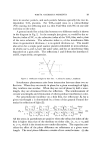
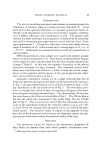
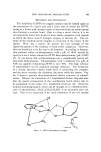
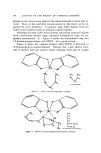
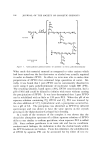
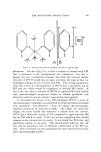
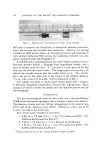
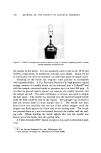
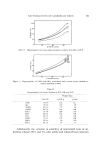
78 JOURNAL OF THE SOCIETY OF COSMETIC CHEMISTS haves optically like two platelets of TiO2, since the mica under most cir- cumstances makes little optical contribution. The thickness of the TiO2 layer determines the color of the nacreous pigment. A particle coated with a relatively thin layer of TiOe reflects bluish white. A slightly thicker TiOe layer reflects yellowish white. In- creasing thickness, so long as the thickness is uniform, produces reflections which are successively yellow, magenta, purple, blue, and green. A still greater thickness produces a second yellow, and so on. The colors are, of course, created by light interference. This paper will demonstrate that the reflectance and therefore the luster of white nacreous pigments are also interference phenomena. Figure 1 is a schematic diagram in cross section of TiOe-mica plate- Jets in a transparent film, such as a nail enamel film. For simplicity, the edges of the platelets are squared off, and bending ot5 light by refraction is omitted. The nacreous effect is derived primarily from the specular or mirrorlike reflection which is composed of light reflected simultaneously from many layers of platelets. Each TiOe layer acts like a transparent mirror which reflects a part and transmits the remainder of the incident light. Some light, which is reflected or scattered in random directions by platelet edges, imperfections in platelet surfaces, or disoriented platelets, gives rise to diffuse reflection. Visually, nacreous luster is high when specular reflection is high and diffuse reflection is low. Figure 1. Reflection o[ light by TiO2-coated mica platelcts. S, specular reflection D, diffuse reflection T, transmission Reflection from a Thin Film Each of the TiO2 layers in Fig. 1 is a thin film. These layers are all of the same thickness however, the thickness ot5 the mica platelet between the two TiOe films is uncontrolled. The optical contribution of the mica thickness in one particle therefore tends to cancel the contribution of the
Purchased for the exclusive use of nofirst nolast (unknown)
From: SCC Media Library & Resource Center (library.scconline.org)