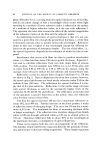
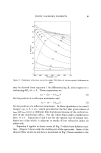
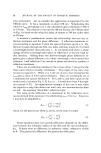
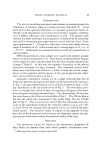
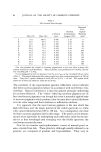
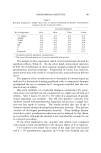
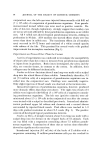
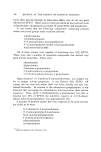
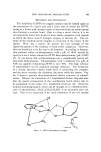
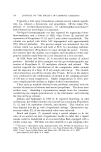
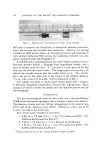
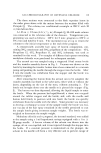
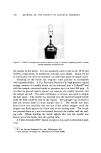
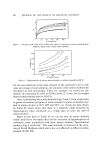
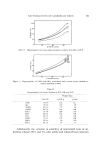
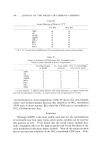
WHITE NACREOUS PIGMENTS 85 4oo 4•o 5oo 5•o Wovelenqth (nm ) Figure 4. Experimental reflectance curves of TiO•-coated mica of various TiO• optical thick- nesses, in nitrocellulose. Reflectance relative to BaSO4 guanine-hypoxanthine ratio (guanine is always the major component) and in shape, depending on the species and tissue. Figure 5 compares spectrophotometric curves of two types of crystals from the herring, Clupea harengus. The top curve is for the "plates" (approximately 30 X 6 X 0.07/•m) obtained from scales, the bottom curve for the very broad crystals (up to approximately 130 X 70 X 0.02 vm) from the swimbladder. The swimbladder crystals are less than one-third as thick as the scale crystals rough estimates of the thickness of swimbladder crystals from the shadow lengths on electron microscope replicas gave values ranging from 15-28 nm, with an average of about 23 nm (6). The concentrations in the drawdown solutions were adjusted in accordance with the thick- nesses to make the reflecting areas the same in both cases, i.e., 2.1% scale crystals versus 0.59% swimbladder crystals. The scale crystals are 76% guanine-24% hypoxanthine, the swimbladder crystals 90% guanine- 10% hypoxanthine. The effective refractive index for light perpen- dicularly incident to the plate is about 1.85 in each case. The curve of the scale crystals has a maximum at about 520 nm. Ac- cordingly, these platelets fall in the range of maximum luster. Optical

86 JOURNAL OF THE SOCIETY OF COSMETIC CHEMISTS •6 Glear Lacquer ,•00 ,• •0 5•0 5•0 6oo 65o 7oo Wovelen•7th (nrn) Figure 5. Reflectance curves of guanine plates from herring scales and swimbladders thickness is approximately 130 nm. The curve for the swimbladder crystal reveals much lower reflectance it is typical of very thin films which reflect bluish white. The swimbladder platelets have an estimated opti- cal thickness of 36 nm based on the shape of the reflectance curve. The geometrical thickness is thus 36/1.85 or 19 nm, in the range found by electron microscopy. The difference between the two types of crystals is inherent in the apparent functions of these crystals in the fish. Denton has shown that the reflection of the guanine crystals in the scales and skin of fish provides camouflage for the fish (7). The platelets are oriented in such a fashion that in daylight the fish seen from any position (except directly below) reflects the amount of light which matches that of its surroundings, and is thus effectively hidden. The thickness of the pearl essence platelet is such as to produce maximum reflectance. Reflection is not pertinent to an internal organ like the swimbladder, a major function of whi.ch is to expand and contract with gas to vary the buoyancy of the fish. In the case of the conger eel, Denton et al. report that it is the silvery guanine- containing layer which makes the swimbladder relatively impermeable to nitrogen, oxygen, and carbon dioxide (8). Permeability is presumably
Purchased for the exclusive use of nofirst nolast (unknown)
From: SCC Media Library & Resource Center (library.scconline.org)