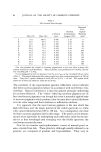
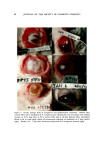
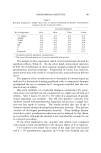
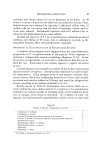
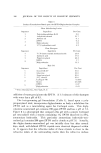
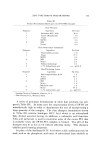
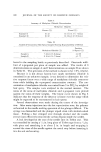
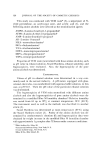
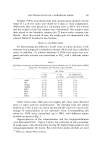
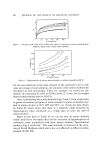
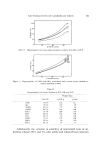
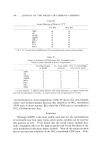
PSEUDOMONAS KERATITIS 95 erythema and edema (about 2.5 cm in diameter) in 24 hours. At 48 hours, a 1-cm area ot• necrosis was observed it persisted for at least 7 days. Similar results were obtained by injecting 2 additional rabbits with 1.5 million cells per site except that the areas ot• erythema, edema, and ne- crosis were reduced. Intradermal injection with 0.15 million cells re- sulted in only slight edema in two other rabbits. Intradermal injection ot• 0.1 ml ot• pseudomonas endotoxin produced erythema and edema in 24 hours, but no subsequent necrosis, as dis- tinguished from the effect with pseudomonas organisms. Mechanism o[ Tissue Destruction in Pseudomonas Keratitis A number of investigators have suggested that the tissue-destructive propensities ot• P. aeruginosa reside in the capacity ot• the organism to elaborate a collagenolytic enzyme resembling collagenase (9, 10). In the next series of experiments, we were able to demonstrate that this was in- deed the case. Furthermore, this enzyme appears to require activation in vivo. Corneal buttons were excised t•rom rabbits 72 hours after intracorneal injection with P. aeruginosa. (Pseudomonas endotoxin was used in simi- lar experiments.) TT• ,,• adequate positive and negative controls, these corneal tissues, which were undergoing destruction in vivo, were excised, incubated with suitable buffers for 24 hours, and tested for collagenolytic activity according to the method of Mandl et al. (11). Results, shown in Table II, demonstrate that corneas which are ac- tively undergoing tissue destruction by P. aeruginosa or by pseudomonas endotoxin are indeed capable of releasing amino acid breakdown prod- ucts of collagen when tested as described. No evidence of active col- lagenase w. as demonstrated in pseudomonas cultures alone or when such Table II Results of Tests for Collagenolytic Activity a Collagenase q- collagen q- Collagenase q- cornea q- Cornea, 72 hr after intracorneal injection of P. aeruginosa q- Cornea, 72 hr after intracorneal injection of pseudomonas endotoxin q- Pseudomonas culture -- Pseudomonas culture q- collagen -- Pseudomonas culture q- cornea -- Endotoxin -- Endotoxin q- cornea -- According to method of Mandl et al. (ll).

96 JOURNAL OF THE SOCIETY OF COSMETIC CHEMISTS cultures were incubated with excised normal corneas. Results with endotoxin paralleled those with P. aeruginosa qualitatively, although there was a quantitative reduction in lytic activity. The fact that col- lagenolytic activity is not seen when excised normal corneas are incubated with P. aeruõinosa or with endotoxin suggests that an enzyme activator is needed. The activator may be produced in vivo during a pseudomonas infection or in response to intracorneal injection of endotoxin. This needs to be confirmed. DISCUSSION These experiments show that under conditions involving defined numbers of pseudomonas organisms and certain defects in the corneal epithelium, rabbit eyes develop pseudomonas keratitis. The effects ap- pear to be more serious in rabbit eyes than in monkey eyes, and the se- quence of destructive events progresses more rapidly in rabbits. It is not possible from these limited studies to say conclusively which species is more representative of man. Nevertheless, the effects are sufficiently similar in both species to warrant concern about their application to man, particularly with regard to current eye-decorating practices among women. A report from Wilson et al. (12) states that the outer eyes of women who use eye cosmetics often harbor pseudomonas organisms which are transferred to their eye liners, mascaras, and eye shadows, where growth may continue. Later, these potentially infectious materials are reapplied to the eyes. This situation could have unpleasant consequences, es- pecially for contact lens users, whose eyes may more readily suffer slight penetration of the corneal epithelium. In this connection, it is note- worthy that a combination of pseudomonas contamination and corneal injury from a commercial shampoo (which was subsequently removed from the market) was capable of initiating pseudomonas keratitis in rabbits. For some time, the Food and Drug Administration has been concerned about the inadequacy of preservative systems in cosmetics (1 g). Mercury, which is not condoned in other cosmetics (14), is currently tolerated in eye-area cosmetics (15), pending the development of better preservative systems for eye preparations. This decision is based on the fact that mercury is markedly effective against pseudomonas organisms in these eye cosmetics (16). Furthermore, systemic mercury poisoning and skin sensitization from these amounts of mercury are unlikely.
Purchased for the exclusive use of nofirst nolast (unknown)
From: SCC Media Library & Resource Center (library.scconline.org)