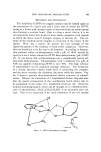
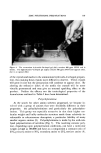
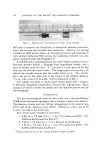
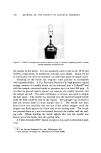
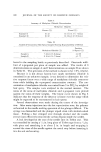
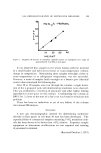
J. Soc. Cosmet. Chem., 23, 115-124 (February 3, 1972) Gas Chromatographic Determination of Methylene Chloride in Aerosol Hair Sprays ROBERT SCHUBERT, B.S., • and LOUISE KETELt Presented May 25, 1971, Seminar, Washington, D.C. Synopsis--An inexpensive SAMPLING DEVICE constructed of an aerosol transfer button, a small piece of polyethylene tubing, and a hypodermic needle is used to transfer a sample of HAIR SPRAY into a stoppered serum bottle. The liquid sample is injected into the GAS CHROMATOGRAPH (gc) with a commercially available high-pressure liquid sampling syringe. A three-segqnent series gc colmnn separates the propellants, solvents, and internal standard in less than 10 minutes. Thermal conductivity is the mode of detection used. The reproducibility of the method when used in analyzing commercial samples con- taining 7-8% METHYLENE CHLORIDE is shown to be better than +2% relative. De- tector response of methylene chloride to the internal standard is linear from 3 to 20% methylene chloride in the sample. INTRODUCTION Hair spray formulations incorporating methylene chloride as a vapor pressure depressant with fluorinated hydrocarbons are being ad- vocated because of reduced costs (1). It is desirable that an analytical method be available to determine methylene chloride in hair sprays di- rectly in a minimum time. It is also advantageous if the method is si•nple, relatively inexpensive to perform, and quick, particularly if it is to be used as a quality control tool. It must also be accurate and repro- ducible. * The Gillette Company, Personal Care Division, Merchandise Mart, Chicago, Ill. 60654. ? 3950 Lake Shore Drive, Chicago, Ill. 60613. 115

116 JOURNAL OF THE SOCIETY OF COSMETIC CHEMISTS Typically, a hair spray formulation contains several volatile ingredi- ents, e.g., ethanol, a denaturant, and propellants. Of the latter, Pro- pellants 11 (trichlorofluoromethane), 12 (dichlorodifluoromethane),* and isobutane are used singly or in mixtures. Gas-liquid chromatography was first reported for separating chloro- fluoromethanes and a solvent in 1956, when Green (2) reported the separations of Propellants 11, 12, and 13, and carbon tetrachloride. The column was packed with Celite 545* impregnated with approximately 30% dibutyl phthalate. The gaseous sample was introduced into the column which was jacketed and held at 24øC by circulating trichloro- monofiuoromethane (Propellant 11) vapor through the jacket. Twenty- five minutes later the analysis was complete and calculation of the com- ponents could be made from the curve obtained on a 5-mv recorder. In 1956, Root and Maury (3, 4) described the analysis of aerosol products. Included in their examples was the gas chromatographic sep- aration of Propellants 11, 12, methylene chloride, and ethanol. The method required the volatilization of the components under vacuum and the injection of a large (9.15 ml) sample into the gc. The alcohol, which eluted last, was off the column after 18 min. Errors in the analysis were attributed to the condensation o•: alcohol at the sampling pressure of 150 mm at room temperature. Higher temperatures or lower pres- sures complicated the analyses at higher alcohol concentrations. These early gc methods disclosed some problems associated with the analysis of mixtures of solvents and aerosol propellants. The three most evident were: obtaining a representative sample from the container transferring the sample quantitatively to the instrument and reducing the time on the gc column. Jenkins and Amburgey in 1959 (5, 6) reported dissolving, in cold cyclohexane, the chilled contents of an aerosol can containing Propellants 11, 12, and 114, methylene chloride, and ethanol. This solution was then injected into the gc with a hypodermic syringe. Quantitative sep- arations within 2% of the theoretical value were achieved. Brook and Joynet (7) reported using a special adaptor to fit the valve of an aerosol can and a hypodermic needle in order that a liquid sample could be transferred to an evacuated glass flask equipped with a rubber serum cap. The flask was then attached to a gas sampling valve * "Genetron," Allied Chem. Corp., Industrial Chem. Div., PO Box 70, Morristown, N.J., 07960 "Freon," E. I. du Pont de Nemours g: Co., Inc., Freon Products Div., Wilmington, Del. 19898 "Ucon," Union Carbide Chem. and Plastics Div., 207 Park Ave., N.Y. 10017. ?Johns-Manville, 22 E. 40 St., N.Y. 10016.
Purchased for the exclusive use of nofirst nolast (unknown)
From: SCC Media Library & Resource Center (library.scconline.org)