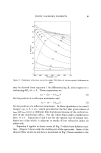
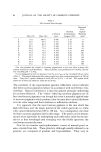
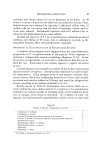
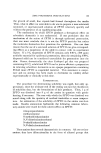
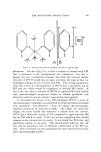
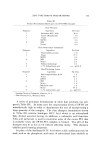
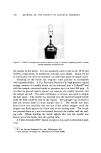
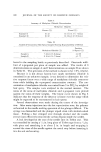
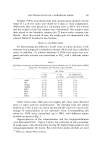
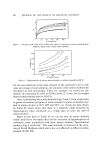
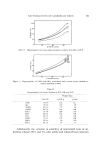
NEUTRALIZATION OF CARBOXYLIC RESIN 127 Samples of 90% neutralized resin with various amino alcohols (in the range of 1 g of dry resin) were dried for 2 days at room temperature. Afterwards, they were placed in a circulating oven at 105øC for 4 hours and the weights of the dry samples were determined. Dry samples were then placed in the humidity chamber for 72 hours under constant con- ditions. After this period of time, the weight gain was determined with a Sauter Balance* installed in the chamber. REsuI•rs AND DISCUSSION For determining the difference in pH value of amino alcohols, 0.1M solutions were prepared in anhydrous ethanol (40-A) and also in distilled water. In addition, 3% ethanol solutions of VEM resin solids were pre- pared and each solution was neutralized to 90% with a different amino alcohol. Table I pH Values of Aqueous and Ethanol Solutions of Amino Alcohols and 3% Total Solids of VEM Resin 90% Neutralized with Various Amino Alcohols pH Value 0. IM 0.1M 3% VEM-(90% in H20 in EtOH neutralized in EtOH) AMP AB AEPD AMPD MEA DEA TEA TIPA 11.23 11 12 10 78 10 70 11 07 10 75 10 23 10 32 10.55 8 10.22 8 10.25 8 l0.23 8 10.12 8 9.80 8 9.45 7 9.30 7 96 71 65 65 67 31 66 62 Table I shows that AMP gives the highest pH value when dissolved alone or when used for neutralization. By selecting from the amino alcohols in Table I, one can obtain the desired pH value for a given per- centage of neutralization of the carboxylic resin. Corresponding pH values for VEM resin, neutralized up to 100% with different amino alcohols, are given in Fig. 1. Hygroscopicities of the ethanolamines and the isopropanolamines were determined first. Figure 2 shows big variations in the percentage of weight gain, with ethanolamine having the highest hygroscopicity and triisopropanolamine the lowest. But when these amino alcohols are used *Sauter Co., Ebingen-Wiirt., Germany.

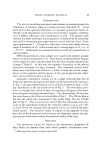
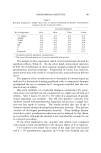
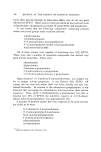
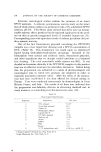
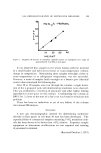
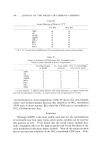
128 JOURNAL OF THE SOCIETY OF COSMETIC CHEMISTS AMP AMPD AEPD DEA TEA • TIPA 7 6 20 4 80 100 % Neutrolizotion Figure 1. Change in pH value of 3% VEM resin solids in anhydrous ethanol neutralized to different degree with various amino alcohols MEA MIPA I .E 150 o (_9 50 • • =.__.. -=---=-- 0 ' I , I , I , 70 80 90 % Relotive Humidify Figure 2. Hygroscopicity of various amino alcohols vs. relative humidity at 30ø0 for the neutralization of the same amount of the carboxylic resin to the same percentage of neutralization, the amounts of the amino alcohols are calculated in mol percentages. Then, for example, we would use the amount of ethanolamine (mol wt 61.09) about 2.5 times less by weight than triethanolamine (mol wt 149.19). After recalculating the results from the Figs. 2 and 3, from weight gain in grams of moisture per gram of amino alcohol to grams of moisture per mol of amino alcohol at 85% RH and 30øC, we obtain the data shown in Table II, which shows that there is a relatively small variation in hygroscopicity when calculated as a weight gain of water per mol of amino alcohol. Based on the data in Table II, we can say that all amino alcohols tested would have but small effect on the variation in hygroscopicity of carboxylic resin, neutralized with these amino alcohols. Experimental results in Fig. 4 verify this. The same similarity is observed in the varia- tion of Sward Hardness which also is not very affected by different amino alcohols (Table III).
Purchased for the exclusive use of nofirst nolast (unknown)
From: SCC Media Library & Resource Center (library.scconline.org)