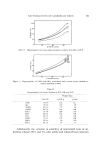
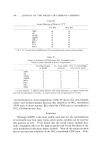
WHITE NACREOUS PIGMENTS 87 reduced because the oriented platelike particles greatly increase the length of the diffusion path. Crystals which fulfill this function need not be reflective. Indeed, a given amount of guanine is used more efficiently if the crystals are thin. These examples show how reflectance is dependent on platelet thick- ness, in agreement with interference behavior. They also illustrate the amazing ingenuity of biological processes which modify crystal dimen- sions, as required, to perform diverse functions. SUMMARY Reflectance curves for thin films, thinner than those which produce interference color, have been calculated from a form of the Fresnel equa- tions dealing with interference behavior of thin films. Spectrophoto- metric curves at specular reflection were then measured for a series of ti- tanium dioxide-coated mica pigments with different TiO2 layer thick- nesses. The experimental curves were found to conform very closely in shape to the theoretical curves for interference films. The similarity demonstrates that the behavior of even "white" nacreous pigments is pri- marily an interference phenomenon. ACKNOWLEDGMENT The authors wish to express their gratitude to Mr. Louis Armanini for the preparation of the special TiO2-coated mica samples, and to Mr. Philip Greenberg for the preparation of the sample of swimbladder crystals. (Received June 7, 1971) RWFERWSCWS (1) Grecnstein, L. M., Nacreous pigments and their properties, Proc. Sci. Sect. Toilet Goods Ass., 45, 20-6 (May, 1966). (2) Vaslcek, A., Optics o[ Thin Films, North-Holland Publishing Go., Amsterdam, 1960, pp. 99, 122-32. (3) Greenstein, L. M., and Bolomey, R. A., An instrumental study of the optical characteris- tics of nacreous pigments and interference pigments, J. Soc. Cosmet. Chem., 22, 161-77 (1971). (4) Linton, H. R. (to E. I. du Pont de Nemours and Go.), Nacreous pigment compositions, U.S. Patent 3,087,828 (1963). (5) Quinn, C. A., Rieger, C. J., and Bolomey, R. A. (to The Mearl Corp.), Method of coating surfaces with high index oxides, U.S. Patent 3,437,515 (1969). (6) Miller, H. A., and Bienes, H., private communication (19õ1). (7) Denton, E. J., On the organization of reflecting surfaces in some marine animals, Phil. Trans. Roy. Soc. London, Set. B, 258, 285-313 (May, 1970). (8) Denton, E. J., Liddicoat, J. D., and Taylor, D. W., hnpermeable "silvery" laycrs in fish, J. Physiol. (London), 207, 64-5P (January, 1970).

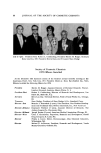
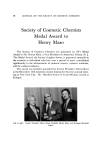
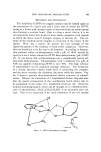
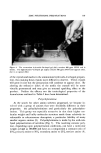
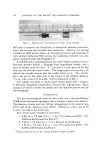
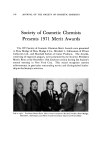
88 JOURNAL OF THE SOCIETY OF COSMETIC CHEMISTS LeJt to right: President-Elect Robert L. Goldemberg, President Martin M. Rieger, Secretary Betty Lou Day, 1971 President Morris Root, and Treasurer Shaw Mudge Society of Cosmetic Chemists 1972 Officers Installed At the December 13th luncheon session of the Society's annual scientific meeting at the Americana Hotel, New York City, 1971 President Morris J. Root, Barr-Stalfort Co., Niles, Illinois, installed the following Officers for 1972: President President-Elect Secretary Director--East Director--M idwest Director--Midwest Director--West Director Director Martin M. Rieger, Associate Director of Chemical Research, Warner- Lambert Research Institute, Morris Plains, N.J. Robert L. Goldemberg, Director of Research and Development, Van Dyk & Co., Belleville, N.J. Betty Lou Day, Technical Services, Polak's Frutal Works Inc., Chicago, Ill. Shaw Mudge, President of Shaw Mudge & Co., Stamford, Conn. Maurice L. Rosenthal (3 years), Vice President, New Product Develop- ment and Technical Sales, Robeco Chemicals, Inc., New York City Rosemarie Wallisch (3 years), Associate Director of Research, The Andrew Jergens Co., Cincinnati, Ohio Joseph Jerome (2 years), American Medical Association, Chicago, Ill. Chris A. Christensen, Supervisor, Research and Development, Rexall Drug Company, St. Louis, Mo. Phyllis J. carter, Editor, Chemmunique, Atlas Chemical Industries, Wilmington, Del. Maison G. deNavarre, President, Research and Development, Vanda Beauty Counsdor, Orlando, Fla.
Purchased for the exclusive use of nofirst nolast (unknown)
From: SCC Media Library & Resource Center (library.scconline.org)