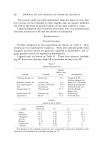
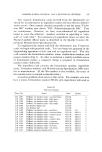
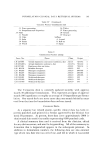
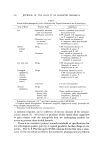
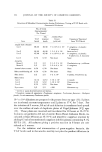
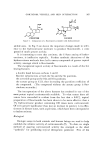
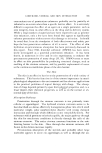
526 JOURNAL OF THE SOCIETY OF COSMETIC CHEMISTS The present study has been undertaken from the point of view that this concept can be extended to other liquids--that an organic molecule also will be adsorbed on powder surface in the same manner as water. Liquid adsorption and wettability of powders were also measured and discussed in relation to SP and the amount of adsorption. EXPERIMENTAL Powder Samples Powders employed in this experiment are shown in Table I. Most of them are raw materials for cosmetics. They were selected widely from inorganic powders which are generally regarded as hydrophilic, and or- ganic powders which are regarded as hydrophobic. Liquids used are shown in Table II. These were selected, consider- ing SP, from water having a high SP to n-hexane having a low SP. Table I Powder Samples Used Specific Surface Area Powder Remarks (m2/g) Manufacturer Titanium dioxide (A) Rutfie-type 10.3 Titanium dioxide (B) Anatase-type 8.6 Iron oxide hydrate Goethite. a-FeOOH 14.5 Talc Manchurian 7.2 Carbon black (A) Channel-type 217.3 Carbon black (B) Channel-type 104.6 Lake Red C Ba salt 67.0 Typaque R-820, Ishihara Sangyo Ltd. Reagent E, Merck AG. Prepared for pigment Nihon Biryushi Ltd. Nittetsu Kagaku Kogyo Ltd. Cabot Corp. Toyb Ink Ltd. Table II Liquids Used in Study Solubility Liquid Parameter Water 23.2 6.00 15.3 16.7 Methanol 14.5 7.42 6.0 10.9 n-Propanol 11.9 7.75 3.3 8.5 Acetone 10.0 7.58 5.1 3.4 Benzene 9.15 8.95 0.5 1.0 Cyclohexane 8.2 8.18 0 0 n-Hexane 7.3 7.24 0 0 • The division of the solubility parameter into components representing dispersion inter- actions, •D, polar bonding, /Sv, hydrogen bonding, ba (5).

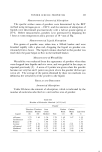
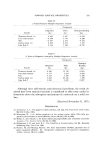
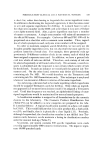
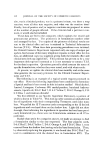
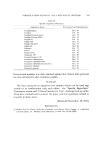
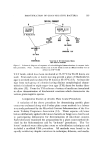
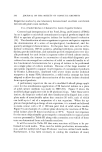
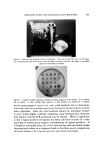
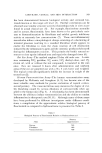
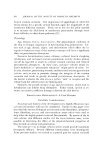
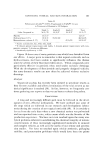
POWDER SURFACE PROPERTIES 527 Measurement of A mount of Adsorption The specific surface areas of powders were determined by the BET method using nitrogen gas at --196øC, and the amounts of adsorption of liquids were determined gravimetrically with a helical quartz spring at 25øC. Before measurement, powders were pretreated by degassing for 1 hour at room temperature and a pressure of 10 4 mm of Hg. Measurement of Liquid Absorption Five grains of powder were taken into a 100-ml beaker and were kneaded rapidly with a glass rod, dropping the liquid on powder con- tinuously from a buret. The liquid volume absorbed in the powder was read when the paste began to flow in the inclined beaker. Measurement of Wettability Wettability was evaluated from the appearance of powders when they were dropped into liquids and vice versa, and was graded in five steps, as reported previously (3). A score of 5 points was given when the powder became wet very fast and 1 point was given where the powder did not get wet at all. The average of the points obtained by these two methods was defined as the wettability of the powder to the liquid. RESULTS AND DISCUSSION A mount of Adsorption Table III shows the amount of adsorption, which is indicated by the number of molecules adsorbed on a unit surface area of powder. Table III Number of Molecules Adsorbed (X 1014/cm 2) Powder Titanium Titanium Iron Carbon Carbon Dioxide Dioxide Oxide Black Black Lake Red Liquid (A) (B) Hydrate Talc (A) (B) C n-Hexane 1.73 1.40 1.96 1.78 1.62 1.67 1.55 Cyclohexane 1.75 . .. 2.04 1.23 1.71 . . . 1.77 Benzene 2.48 ... 1.85 1.68 1.93 ... 1.63 Acetone 3.37 2.56 2.56 1.98 2.66 2.61 1.74 n-Propanol 2.77 2.60 2.43 1.82 2.62 2.70 1.40 Methanol 4.47 3.89 4.79 2.12 3.58 3.59 1.90 Water 9.02 6.70 9.36 4.00 6.12 7.82 2.45
Purchased for the exclusive use of nofirst nolast (unknown)
From: SCC Media Library & Resource Center (library.scconline.org)