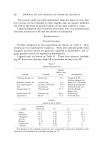
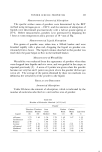
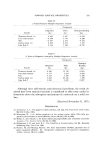
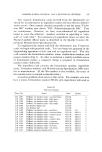
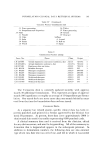
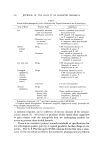
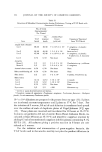
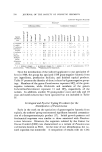
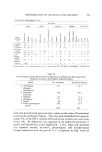
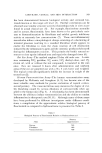
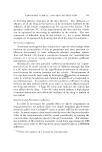
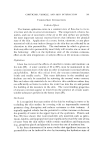
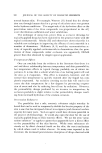
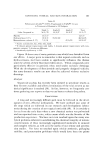
POWDER SURFACE PROPERTIES 527 Measurement of A mount of Adsorption The specific surface areas of powders were determined by the BET method using nitrogen gas at --196øC, and the amounts of adsorption of liquids were determined gravimetrically with a helical quartz spring at 25øC. Before measurement, powders were pretreated by degassing for 1 hour at room temperature and a pressure of 10 4 mm of Hg. Measurement of Liquid Absorption Five grains of powder were taken into a 100-ml beaker and were kneaded rapidly with a glass rod, dropping the liquid on powder con- tinuously from a buret. The liquid volume absorbed in the powder was read when the paste began to flow in the inclined beaker. Measurement of Wettability Wettability was evaluated from the appearance of powders when they were dropped into liquids and vice versa, and was graded in five steps, as reported previously (3). A score of 5 points was given when the powder became wet very fast and 1 point was given where the powder did not get wet at all. The average of the points obtained by these two methods was defined as the wettability of the powder to the liquid. RESULTS AND DISCUSSION A mount of Adsorption Table III shows the amount of adsorption, which is indicated by the number of molecules adsorbed on a unit surface area of powder. Table III Number of Molecules Adsorbed (X 1014/cm 2) Powder Titanium Titanium Iron Carbon Carbon Dioxide Dioxide Oxide Black Black Lake Red Liquid (A) (B) Hydrate Talc (A) (B) C n-Hexane 1.73 1.40 1.96 1.78 1.62 1.67 1.55 Cyclohexane 1.75 . .. 2.04 1.23 1.71 . . . 1.77 Benzene 2.48 ... 1.85 1.68 1.93 ... 1.63 Acetone 3.37 2.56 2.56 1.98 2.66 2.61 1.74 n-Propanol 2.77 2.60 2.43 1.82 2.62 2.70 1.40 Methanol 4.47 3.89 4.79 2.12 3.58 3.59 1.90 Water 9.02 6.70 9.36 4.00 6.12 7.82 2.45

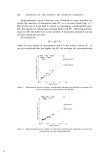
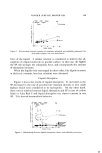
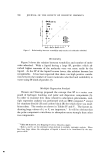
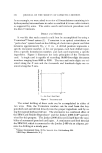
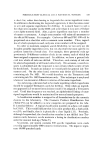
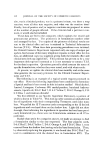
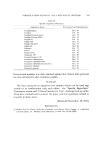
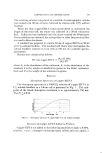
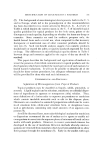
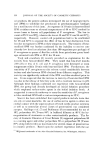
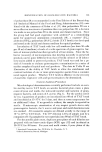
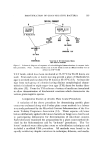
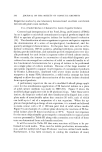
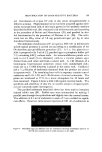
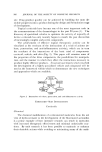
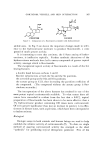
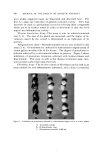
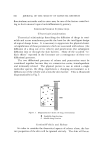
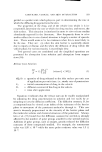
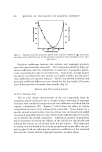
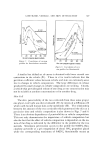
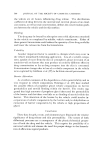
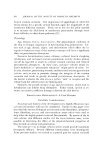
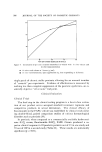
528 JOURNAL OF THE SOCIETY OF COSMETIC CHEMISTS Approximately linear relations were obtained in some powders be- tween the amount of adsorption and SP, as is obvious from Figs. 1-3. But in the case of Lake Red C, which is regarded as a hydrophobic pow- der, the amount of adsorption changed little with SP. With liquids hav- ing a low SP, the difference in the number of molecules adsorbed was not obvious among the powders. SP is defined as se = where E is the energy of vaporization and V is the molar volume (4). It can be considered that the higher the SP, the stronger the intermolecular n hexane acetone methanol wat,•r cyclo •xane n prap. ano! b•nzene • •ltanlum dioxide Solubd•ty Parameter Figure ]. Re]aLionship beLweeu nmnber or molecules adsorbed and solubility parameLer [or titanium dioxide (A) and titanium dioxide n hexane acetone methanol wa•er cyc•ot]exane An propanol • 10 •%zene • & Carbon black • B ) ///Carbon black •,A } $01uhhty Parameler Figure 2. Relationship between number of molecules adsorbed and solubility parameter for carbon black (A) and carbon black (B)
Purchased for the exclusive use of nofirst nolast (unknown)
From: SCC Media Library & Resource Center (library.scconline.org)