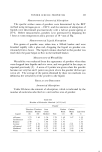
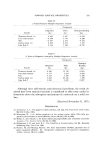
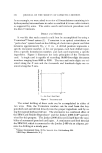
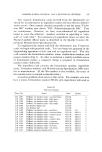
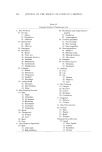
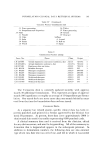
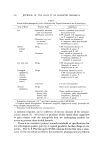
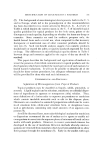
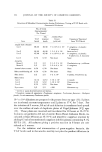
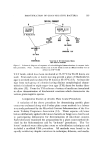
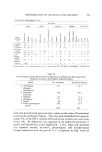
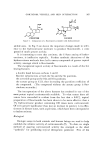
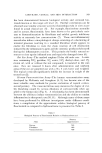
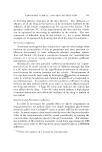
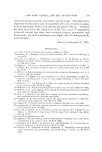
IDENTIFICATION OF GRAM-NEGATIVE BACTERIA 559 Used to Speciate Gram-Negative Isolates Reactions a Other I MVic Enzymes NOaRd c Op-Tempd P. aeruginosa --R + q- -- -- -- + q- q- p q- -- -- q- -- q- + P. stutzeri --R q- q- -- -- -- + -- -- K q- -- -- + -- + + P. multivorans -- R (+) Enterobacter aerogenes -- R + S. raarcescens --R (+) (+) -- -- E. coli --R (+) -- (+) Klebsiella -- R -- A lcaligenes f aecaloes -- R q- + -- -- -- + -- -- K q- (q-) Adnetobacter anitratus -- Cob ..... + + + + + + + + (+) + + + + + + + + (+) + + - usually positive (--) ---- usually negative (A) = usually acid R = rod Cob = ½occobacillus. b Reactions on Table IV Gram-Negative Groups Detected During Speciation of Isolates from Raw Ingredients, Production Facilities, and Finished Topical Products Group No. of Isolates % of Total Isolates 161 10.3 1. Achromobacter Alcaligenes Flavobacterium 2. Enterobacter Escherichia 3. Klebsiella 4. Pseudomonas 5. Serratia 6. Other gram-negative genera 158 10.2 175 11.3 771 49.8 84 5.4 201 13.0 1550 100 indicated that they had speciated their isolate on the basis of biochemical patterns plus serological typing. They also had established that approxi- mately 5% of the EO-1 variants of Pseudomonas multivorans were non- motile (18). By definition, any organism in the genus Pseudomonas is motile and should have polar flagellation. Later, Adair and associates (19) reported unusual metabolic, physiological, and ultrastructural changes associated with the growth of P. aeruginosa in high levels of

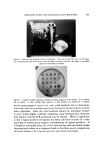
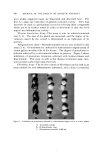
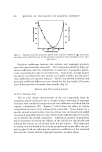
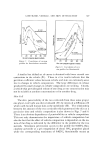
560 JOURNAL OF THE SOCIETY OF COSMETIC CHEMISTS quaternary ammonium compounds. The change of properties included loss of respiratory chain components, stabilization of the cell wall mem- brane complex to physicochemical disruption, the presence of cyto- plasmic inclusions and membranes, altered immunogenicity, decreased pathogenicfry, and increased sensitivity to other surface-active anti- microbials. Furthermore, many of their strains resistant to quaternary ammonium compounds were nonmotile. As a result of this experience our group has developed hyperimmune sera (20) against 5 strains of P. aeruginosa and 3 strains of the EO-1 variants of P. multivorans. The availability of these 8 antisera has been an aid to the rapid speciation of the opportunistically pathogenic strains of Pseudomonas. This laboratory has also investigated the use of pyocines for the typing of P. aeruginosa by the method of Gillies and Govan (21). A}- though pyocine reaction patterns have been developed for some of the isolates of P. aeruginosa collected to date, this method is not used rou- tinely to characterize such isolates. This tool could aid in the tracking of sources of P. aeruginosa contamination in the production environment, but the sophistication ot5 technique required for this diagnostic reaction precludes its immediate adaptation to industrial microbiological labora- tories. Detection of Endotoxins of P. aeruginosa Some manufacturers of topical products, particularly cosmetics, have examined radiation sterilization and liquid sterilizing chemicals as a way to achieve high microbiological quality in finished products (g). It has been pointed out that the use of radiation or sterilizing chemicals with a finished product that is not required to be sterile could cover up poor manufacturing procedures and thus result in the sterilization of filth. Although the presence of filth per se is objectionable under the FDScC Act, it is known that some of the endotoxins from lysed bacterial cells can serve as allergens (22). An analogous situation occurs with some exotoxins of certain strains of S. aureus which have been allowed to grow in foods. The contami- nating staphylococci can be subsequently killed, but ingestion of these exotoxins can produce an enterotoxemia in humans. Thus, it has been necessary to develop serological procedures to detect the presence of staphylococcal enterotoxins in foods (2'3). Studies in this laboratory have been performed with endotoxins pre- pared from P. aeruginosa DM-1167 isolated from a contaminated bath
Purchased for the exclusive use of nofirst nolast (unknown)
From: SCC Media Library & Resource Center (library.scconline.org)