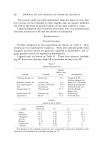
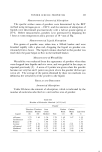
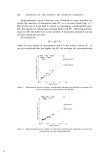
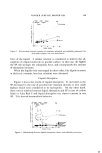
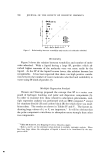
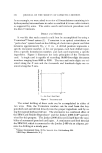
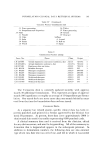
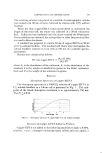
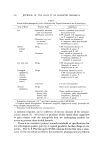
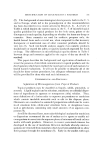
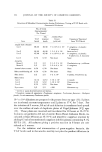
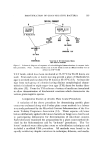
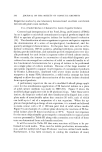
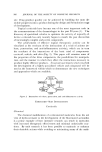
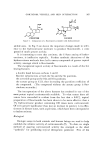
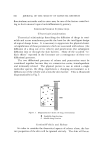
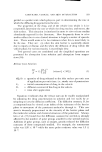
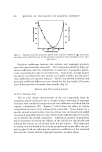
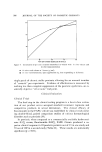
COPPER-EDTA DETERMINATION 547 The resulting solution was placed in a suitable chromatographic column and washed with 100 ml of water, followed by elution with 1.0% sodium bisulfate. When the blue copper-EDTA band moved down to one-fourth the length ot• the resin bed, the eluate was collected in a 50-ml volumetric flask. Collection was continued until the eluate reached the 50-ml mark. If any turbidity was obtained, the syringe filter or other fine porosity filter was used to filter the eluate. A standard was prepared to contain 30 mg ot• copper-EDTA in 50 ml of 0.1 70 sodium bisulfate. The standard and eluate were read against the sodium bisul[ate solution in 5-cm cells at 750 nm in a suitable spectro- photometer. Results were calculated as follows: Per cent copper-EDTA = (A,•) (S) (100) (As) where A•, is the absorbance of the unknown, As is the absorbance of the standard, S is the weight of standard in grams in the 50-ml volumetric flask, and U is the weight of the unknown in grams. RESULTS Absorption Spectrum of Copper-EDTA The absorption spectrum of a 0.0612% solution ot• copper-EDTA in 1% sodium bisulfate in a 5.0-cm cell is presented in Fig. 1. The mid- point of the broad absorption maximum is at approximately 750 nm. The E• % is 0.94. Wavelength , nm Figure 1. Absorption spectrum of copper-EDTA in 1% sodium bisulfate Recovery of Copper-EDTA Added to Products Copper-EDTA was added to the following materials to make a 0.30% solution: water. a shampoo containing lauryl sulfate and coco amine, a

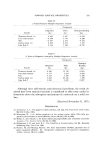
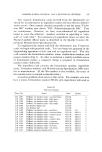
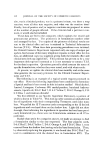
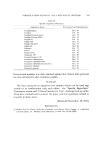
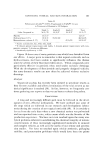
548 JOURNAL OF THE SOCIETY OF COSMETIC CHEMISTS silicone lotion, and a cream containing a gelling agent. These were assayed as described above. The results are given in Table I. Table I Recovery of Added Copper-EDTA Sample Recovery Aqueous solution 96.4, 101.8 99.1 Shampoo 96.4, 99.5, 99.0 98.3 Silicone lotion 101.9, 104.2 103.1 Gel cream 101.2, 98.8 100.0 Average recovery 100.0 DISCUSSION The recovery of copper-EDTA added to a variety of products (Table I) is satisfactory. It is quite probable that the use of other methods such as the determination of copper by atomic absorption following ashing might result in a greater precision. However, this type of approach would not result in a measure of the stability of the entire molecule. Batch technique is a relatively inefficient method of ion exchange. This technique was utilized in the work described above so that a single inethod could be used for a variety of products. If the product under in- vestigation is relatively free of interferences such as lipids and gels, a sample may be applied directly to the ion exchange column, thereby resulting in a significant saving of time. (Received December 13, 1971) REFERENCES (I) Gerstein, T., Personal communicati,on, November 1, 1970. (2) Martell, A. E., an,d Calvin, M., Chemistry o[ the Metal Chelate Compounds, Prentice Hall, Inc,, Englewood Cliffs, N.J., 1952, p. 538.
Purchased for the exclusive use of nofirst nolast (unknown)
From: SCC Media Library & Resource Center (library.scconline.org)