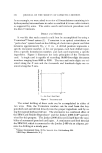
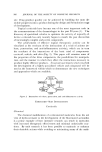
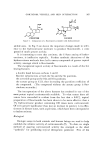
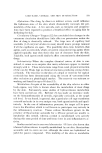
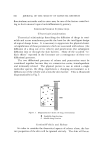
CORTICOID, VEHICLE, AND SKIN INTERACTION 573 garded as a perfect sink which plays no part in determining the rate at which the diffusing drug penetrates the skin. The properties of the drug, and of the vehicle into which it is in-, corporated, determine the rate at which the drug reaches, and enters, the skin surface. This situation is simulated in most in vitro release studies abundantly reported in the literature. How frequently these in vitro studies reflect the in vivo clinical situation is largely a matter of specula- tion. There would seem to be two instances when this is most likely to be the case. They are: (a) when the skin barrier is essentially absent due to injury or disease, and (b) when the diffusion of drug within the vehicle phase, for various reasons, is exceedingly slow. Two general cases are considered and the simplified equations are presented for absorption from solution and absorption from suspen- sions (16). Release from Solution dt - Co\/ (where Q 30%) (1) dQ/dt -- quantity of drug released to the skin surface per unit area of application per unit time i.e., steady rate of penetration. Co = initial concentrati•on of .drug in the vehicle. D,, -- diffusion constant of the drug in the vehicle. t : time after application Equation 1 indicates that the release rate can be readily manipulated by adjusting the drug concentration in solution and less easily by at- tempting to vary the diffusion coefficient. The diffusion constant, D, for a compound may be viewed as an index of the resistance of the barrier phase to movement of the penerrant molecules through it. This con- stant is inversely proportional to the viscosity of the barrier phase and the molecular volume and chemical structure of the penerrant. Scheup- lein et al. (17) found that the diffusion constant for steroids is strongly affected by the number of polar groups attached to the steroid nucleus. Addition of polar groups, such as oxygen, greatly reduced the diffusion constants of those compounds studied. For example, the testosterone value was 1.95 X 10 -• while the more polar cortisone value was 1.3 X 10-•- ø.

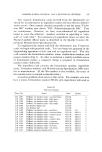
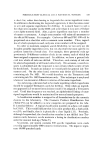
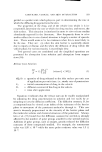
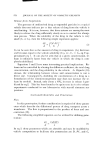
574 JOURNAL OF THE SOCIETY OF COSMETIC CHEMISTS Release lrom Suspensions The presence of undissolved drug as suspended particles in a topical vehicle does not indicate per se that release of drug from the vehicle is rate-limiting. It is true, however, that these systems are among the most likely to release the drug sufficiently slowly so as to control the absorp- tion process. When the solubility of the drug in the vehicle is very small (Cv Co), then the following simple expression applies: ICoC,h •t = X, 2t ? (2) It can be seen that as the amount of drug in suspension (Co) decreases and becomes equal to the vehicle solubility (Cv), i.e., C,•: C0, eq 2 ap- proximates eq 1. It can also be seen that at a given concentration, re- lease is ordinarily faster from the vehicle in which the drug is com- pletely solubilized. Equations 1 and 2 have some interesting practical implications. Re- lease can be controlled by altering the diffusion coefficient, the total drug concentration, and the drug solubility in the vehicle. As Higuchi (16) stresses, the relationship between release and concentration is not a direct one. Consequently, doubling the concentration of a drug in a formulation of the ointment-suspension type does not increase the re- ]ease by twofold. Instead, only about a 40% increase in release is pre- dicted by eq 2. This has been found to be quite true in in vitro release experiments conducted in our laboratories with steroid ointment sus- pensions. Corticoid-lrehicle-Shin and Penetration Flux In skin penetration, further consideration is required of those param- eters which describe the diffusional process of drug transport across a membrane. The flux is proportional to the product of force and con. centration (18). The following simplified equation can be utilized for defining pene- tration: dQ CvD(PC) 2t - h (3) In eq 3, those parameters which are alterable and may be modified by vehicle ccomposition to facilitate skin penetration are D, PC, and Cv
Purchased for the exclusive use of nofirst nolast (unknown)
From: SCC Media Library & Resource Center (library.scconline.org)