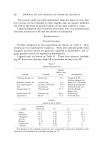
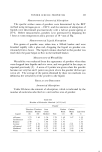
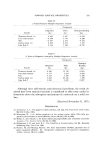
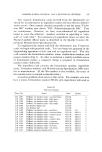
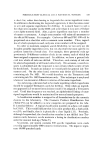
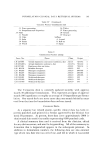
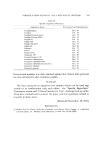
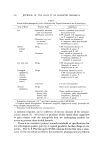
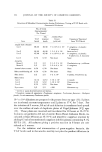
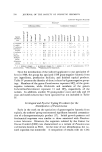
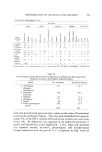
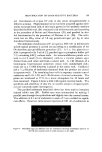
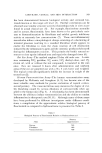
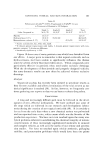
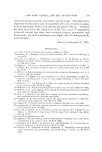
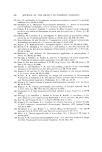
POWDER SURFACE PROPERTIES Table IV to Values Found by Multiple Regression Analysis 531 Component Dispersion Polar Hydrogen Bonding Powder (•D) (•v) (•H) Titanium dioxide (A) 0. 469 3. 967 -- 0. 092 Iron oxide hydrate --0. 418 1. 741 0. 288 Talc -- 0. 569 2. 276 -- 0. 433 Carbon black (A) 0.254 4. 511 1. 337 Lake Red C 0.156 1.960 --0.947 Table V Ratio in Dispersion Analysis by Multiple Regression Analysis Component Powder Hydrogen Dispersion Polar Bonding (&,) (&,) (•) Titanium dioxide (A) 0. 220 15. 738 0. 853 Iron oxide hydrate 0.175 3. 031 0. 083 Talc 0. 324 5.180 0.188 Carbon black (A) 0. 064 20. 346 1.788 Lake Red C 0. 024 3. 841 0. 897 Although there still remain some theoretical problems, the result ob- tained here from statistical analysis is considered to offer some useful in- formation about the adsorption mechanism of a molecule on a solid sur- face. (Received Nove•nber 11, 1971) REFERENCES (1) Zettlemoyer, A. C., The pigment-vehicle interface, Off. Dig., Fed. Paint Varn. Prod. Clubs, 29, 1238-71 (Dec. 1957). (2) Murayama, H., et al., Surface properties of the ternary system Al•Oa--TiO.,--SiOe pre- pared by the hydrolysis of metal alkoxides, Zairyo, 19 (201), 533-6 (1970). (3) Mitsui, T., and Takada, S., On factors influencing dispersibility and wettability of powder in water, ]. Soc. Cosmet. Chem., 20, 335-51 (1969). (4) Hildebrand, J. H., and Scott, R. L., The Solubility of Nonelectrolytes, 3rd Ed., Reinhold Publishing Corp., New York, 1950. (5) Hansen, M., and Skaarup, Klemen, The three dimensional solubility parameter-key to paint component affinities. III. Independent calculation of the parameter components, ]. Paint Technol., 39, 511-4 (1967).

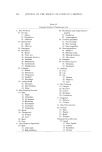
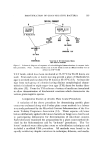
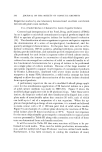
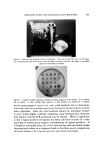
J. Soc. Cosmet. Chem., 23, 5•-543 (August 17, 1972) Cosmetic Formulation-Clinical Data Retrieval Systems SAL D. PELUSO, B.S.,* and LEE N. STARKER, Ph.D.* Synopsis--INGREDIENT and CLINICAL DATA RETRIEVAL SYSTEMS have been de- veloped by the generation of PUNCHED CARDS. A subsequent conversion to Termatrex cards was initiated for the ingredient data, while a computer-generated printout was under- taken to handle the clinical data. The cosmetic ingredient punched cards are used directly in the J-400 Termatrex drill to produce a searchable set of Termatrex cards, and the clinical data punched cards are processed by COMPUTER, producing a printout usable directly as a desk-top tool. INTRODUCTION A system has been designed to relate a specific ingredient or in- gredients to their corresponding cosmetic formulations. Also, the capa- bility to compare these formulations with various clinical studies has been developed to enable the cosmetic chemist to make easy correlations with specific product classifications such as shampoos, skin lotions, lipsticks, etc. With such a system in operation, the cosmetic chemist is able to ask and receive a quick answer as to whether a given ingredient or combina- tion of various ingredients has been previously formulated. If so, in which formulations did it appear, and did any of these preparations show skin irritation or skin sensitivity in the clinic? It has been claimed that it is sometimes less costly to rerun a clinical trial than attempt to retrieve data concerning a specific formulation. This is no longer so for our information collection. In addition, should questions arise concern- ing a specific ingredient contained in marketed products, the formula- tions can quickly be found and their corresponding test data reviewed. • Warner-Lambert Research Institute, 170 Tabor Road, Morris Plains, N.J. 07950. ? Deceased. 533
Purchased for the exclusive use of nofirst nolast (unknown)
From: SCC Media Library & Resource Center (library.scconline.org)