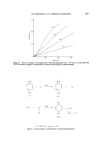
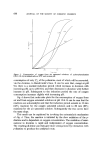
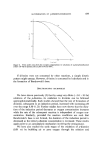
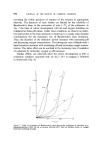
J. Soc. Cosmet. Chem. 23 703-720 (1972) ¸ 1972 Society of Cosmetic Chemists of Great Britain Preservatives for pharmaceuticals H. S. BEAN* Presented on 29th September 1971 in London, at the Symposium on 'Microbial control', organized by the Pharmaceutical Society of Great Britain and the Society of Cosmetic Chemists of Great Britain. Synopsis--Examination of the literature strongly indicates that PRESERVATIVE activity should be biocidal rather than biostatic and underlines the necessity of establishing STAN- DARDS for preservative activity, such standards to include requirements for the rate of kill or time to sterilize specified standard infections in a product and a specification for the capacity of the preservative to deal with successive infections of the product. The chemical availability of a preservative in a product may alter during STORAGE as a result of absorption by the package, in-use infection, or change in storage temperature and the microbiological significance of the loss may be estimated from a knowledge of the concen- tration exponent and/or temperature coefficient of the preservative. The preservative activity of a substance may be markedly influenced by product environ- ment, the more complex the product the greater the number of factors influencing the activity with the result that the preservative activity of a simple AQUEOUS SOLUTION can usually be stated with greater confidence than that of an EMULSION. Nevertheless, with the aid of mathematical models and a knowledge of the appropriate parameters it is often possible to predict the activity of a fluid containing SURFACE ACTIVE AGENTS or an emulsified preparation with acceptable accuracy. For several decades pharmacists have been aware of the need to protect their products against microbial contamination but it is only during the last one or perhaps two decades that serious thought has been applied to the science of preservation. A search through pharmaceutical compendia and texts reveals very few 'traditional' preservatives including ethyl alcohol at a concentration of not less than 20•o, chloroform at 0.25•o, sucrose at 67•o and benzoic acid at 0.1 •o. That they are still used is testimony to their effectiveness but *Department of Pharmacy, Chelsea College of Science and Technology, London, S.W.3. 703

704 JOURNAL OF THE SOCIETY OF COSMETIC CHEMISTS severe limitations in their applicability restrict their use in modern pro- ducts. Alcohol was traditionally the preservative of tinctures and other galenicals the use of which has rapidly declined. Chloroform has been used both as a flavouring agent and preservative in extemporaneously prepared oral preparations with short storage life. It is volatile and readily lost from such preparations and is now losing favour because of possible toxicity. Syrups are still in vogue but temperature cycling during storage can produce a surface layer deficient in sucrose and deficient in antimicrobial activity. Indeed, recommendations to include preservatives in syrups (1) focus attention on possible failures in the use of syrup as a preservative. The physico-chemical properties of benzoic acid place severe restriction on its use. It has only moderate water-solubility (ca 0.28•) but high lipid solubility, for effectiveness must be employed at about half-saturation con- centration which, as will be shown later, detracts from its usefulness and has a pKa of 4.2 which really restricts its employment to acidic preparations. Several reports (2-5) have indicated the widespread nature of con- tamination in pharmaceuticals and stressed the necessity of controlling it Unfortunately, except for sterile products which are outside the purview of this survey, there are no universally recognized standards of what con- stitutes an acceptable number of micro-organisms in a product, the effective- ness of a preservation or even methods of determining preservative activity. Let it be first established that the writer strongly supports the hypothesis that preservation must never be a substitute for good manufacturing practice which can lead to a substantially reduced number of micro- organisms in a product at completion of manufacture. It is rather a safe- guard either to destroy or inhibit the growth of those organisms which cannot be eliminated by good manufacturing practice or which gain access to the product during use. Hitherto, the effectiveness of preservation has usually been assessed by a so-called challenge test. These involve inoculating a product with known organisms and incubating perhaps for many months. The prolonged storage or incubation is a confession of the recognition of the possibility of failure of the preservative effectively to fulfil its role and a number of containers are put on storage in an attempt to quantify the probability of failure. The test is really a measure of the ability of contaminating organisms to destroy the product. I submit that more desirable would be a performance test--a measure of the ability of the product to destroy invading organisms. Such a test would be more positive, more rapidly performed and possibly more easily definable by regulatory bodies.
Purchased for the exclusive use of nofirst nolast (unknown)
From: SCC Media Library & Resource Center (library.scconline.org)