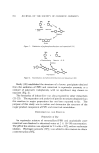
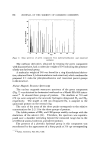
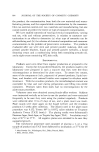
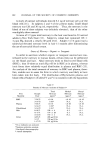
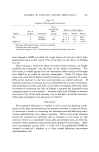
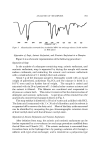
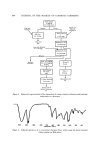
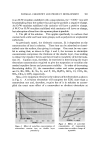
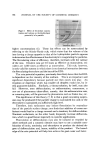
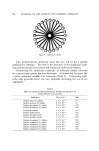
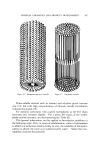
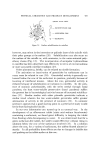
ANALYSIS OF SHAMPOOS 889 Sample •n Acidified Alcohol I • Acidified Alcohol Weakly Basic Ion Exchange Column Alcohol Eluate I Amm.(NH412CO 3 Eluate I [ Evap.-Dissolve I NH 4 Alkyl Sulfate lin Water r: Na2C031 /Evap.-Ext. Acer. I Søap-Na2C03 Residue I Extract H20-Acid I Fatty Acid-Alkanol Ext.
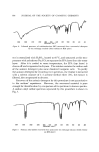
Hot CHCI 3 Amine Condensate Fatty Acids Simplified schematic of Newburger's shampoo analysis scheme (12) Newburger was the first to use infrared spectroscopy in shampoo anal- ysis (19). The spectrum of the nonvolatile residue was examined for the possible presence of soap, alkyl sulfates, alkanolamines, fatty acid-alkanol- amine condensates, polyoxyethylene compounds, polyhydroxy com- pounds, and quaternary ammonium compounds. Other qualitative tests were used and water was determined by the AOAC method (16). Separa- tion of the surfactants was by the ion exchange method (12) and is shown in Fig. 1. The separated fractions were examined by ir and identified by their spectra. Although the procedure outlined is quite comprehensive and makes very good use of technology available, it cannot separate and identify alkanolamines which are popularly used in many modern sham- poos. Puttham (20, 21) applied another ir technique to qualitative and quan- titative analysis of surfactants in shampoos. He used a Teflon ©* seal with a backing plate on the back face of a KRS-5 attenuated total reflec- tance (ATR) prism forming a cell to contain a liquid shampoo which can be scanned by ir. Spectra obtained over the "fingerprint region" were used to identify an ethoxylated alcohol, a sulfated alcohol, and a sulfated fatty alcohol ethoxylate. The qualitative method was adapted to a quan- titative method for lauryl ether sulfate by measuring the sulfate absorbance * E. I. dupont de Nemours Corporation, Wilmington, Del.

890 JOURNAL OF THE SOCIETY OF COSMETIC CHEMISTS at 1220 cm -•. Excellent correlation of the method with the cationic titra- tion method was claimed over the range of 16-19%. It was reported that the method could also be used to determine sodium and triethanolamine salts of sulfated fatty alcohols. Schwarz (22) stated that the analyst must have some idea of the com- ponents to determine how to proceed with the shampoo analysis. He made use of the titrations of Epton (23) and Barr et al. (24) before and after acid hydrolysis, and the hydroxyl number of the fatty alcohol or the acid number of the fatty acid thus liberated. He advised the use of gas chro- matography to determine carbon-chain distribution of the acid or alcohol. He also discussed the practicality of column chromatography, solvent ex- traction, thin-layer and paper chromatography. An ir spectrum might be useful if the mixture is not too complex. A very serious problem to analysis of shampoos, he pointed out, is that the raw materials used in the surfactants are not l•ure. Schwarz stated that, in the analysis of shampoos, a compromise must be made between the cost and the expenditure of time and the desired results. It was Schwarz' opinion that often the results obtained are not worth the expenditure (22). Thin-layer chromatography (tlc) has been used for the separation of ionic and nonionic surfactants, free fatty alcohols, and free amines in shampoos (25). Other workers (26, 27) have used tlc for separating zinc l•yrithione from other shampoo ingredients. Gas chromatography has been used to determine triethanolamine lauryl sulfate (28) and free propylene glycol in shampoos (29). Fairchild (30) suggested a shampoo separation scheme in 1967. The sample was dissolved in water and extracted with petroleum ether. When the water in the aqueous fraction was reduced to a small amount, the cellu- lose precipitated out and could be removed from triethanolamine lauryl sulfate. The two fractions were then dried and determined quantitatively. The methylene blue test of Jones (31) was used to confirm the alkyl sulfate. Other identifications were made by ir spectroscopy. The petroleum ether-soluble components were separated on an alumina column with increasingly polar solvents. Infrared was used to identify the material eluted. The nonionic surfactants were eluted with some of the super- amide and soap in the ethanol fraction. Because of this, the scheme is not as complete as one would like, but it goes a long way toward solving some of the problems previously encountered. There is also some question about the completeness of the separations between some of the fractions. Perfumes in shampoos have been determined qualitatively and quanti- tatively by uv spectrophotometry (32).
Purchased for the exclusive use of nofirst nolast (unknown)
From: SCC Media Library & Resource Center (library.scconline.org)