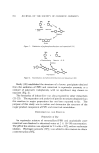
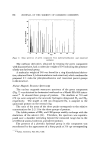
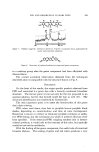
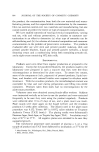
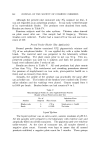
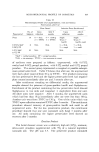
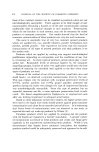
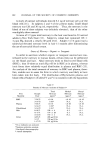
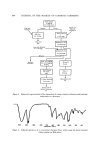
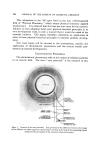
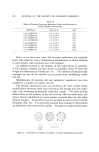
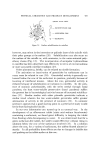
PHYSICAL CHEMISTRY AND PRODUCT DEVELOPMENT SURFACE ACTIVE AGENT • POLYOXCHAINCHAIN • HYDROCARBON • SOLUBILIZATE Figure 13. Surface solubilization in micelles 909 however, may orient in the interstices or palisade layer of the micelie with their polar groups at the surface (28). Solubilization may also occur on the surface of the micelle or, with nonionics, in the water-oriented poly- ethoxy chains (Fig. 13). The incorporation of semipolar hydrocarbons in micelles has been described most effectively in terms of microemulsions or more accurately micellar emulsions (29). Other phenomena, briefly, can be related to micelie formation. The activation or inactivation of germicides by surfactants can in many cases be related to cmc (30). Germicidal activity is generally en- hanced below the cmc of the surfactant in question, probably because of lowering of interfacial tension. Above the cmc, germicidal activity is reduced because of solubilization or inclusion in micelies. In the pres- ence of nonionic polyethoxides, with the series methyl through butyl parabens, the least water-soluble preservative (butyl parabens) suffers the greatest loss in bacteriological activity because of increased solubiliza- tion (31). Similar studies with other phenolic germicides indicate a similar trend wherein the less water-soluble germicides suffer greater attenuation of activity in the presence of nonionics (32). In nonionic systems it appears that a good starting point in a presevative study would be the least hydrophobic biocide. In our own laboratories cmc turned up in an unusual way. In the development of an effervescent tablet (citric acid-sodium bicarbonate) containing a surfactant, we found great difficulty in keeping the tablet from floating while decomposing in water. It was determined that for a given surfactant-free tablet, the tablet would effervesce without rising in solutions below the cmc of the surfactant involved (33). In a solution above the cmc, for a variety of surfactants, the tablets floated almost in- stantly. In all probability these effects are due to changes in bubble size and packing on the tablet surface at the cmc.

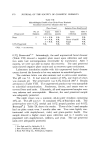
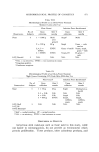
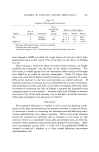
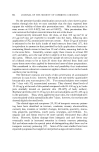
910 JOURNAL OF THE SOCIETY OF COSMETIC CHEMISTS SUMMARY It is evident from the above, that the applications of electrokinetic phenomena and critical micelle concentration theory could play a signifi- cant role in aiding the formulator to better achieve his goals in developing stable products with longer shelf life. (Received February 3, 1972) REFERENCES (1) Stern, Otto, The theory of the electrolytic double-layer, Z. Elektrochem., 30, 508-16 (1924). (2) Henry, D.C., The cataphoresis of suspended particles. I. The equation ofcataphoresis, Proc. Roy. Soc., London, A133, 106-29 (1931). (3) Henry, D. C., The electrophoresis of suspended particles. IV. The surface conductivity effect, Trans. Faraday Soc., 44, 1021-6 (1948). (4) Sennett, P., and Oliver, J.P., Colloidal dispersions, electrokinetic effects, and the con- cept of zeta potential, Chemistry and Physics of Interfaces, American Chemical Sociew, Washington, D.C., 1965, pp. 75-82. (5) Priesing, C. P., A theory of coagulation, Ind. Eng. Chem., 54 (8), 38-45 (1962). (6) Verwey, Evert J. W., and Overbeck, J. T. G., Theory of the Stability of Lyophobic Colloids, Elsevier Publishing Co., New York, 1948. (7) Higuchi, W. I., and Misra, Jagdish, Physical degradation of emulsions via the molecular diffusion route and the possible prevention thereof, J. Pharm. Sci., 51,459 (1962). (8) Haines, Bernard A., and Martin, Alfred N, Interfacial properties of powdered materials caking in liquid dispersions. I, II, III, Ibid., 50, 228,753,756 (1961). (9) Goddard, E. D., and Benson, G. C., Conductivity of aqueous solutions of some paraffin chain salts, Can. J. Chem., 35, 986-91 (1957). (10) Shirahama, K., Micelle formation of some alkyl sulfates in dioxane-water, Bull. Chem. Soc. Jap., 38, 373-8 (1965). (11) Campbell, A. N., and Lakshminarayanan, G. R., Conductances and surface tensions of aqueous solutions of sodium decanoate, sodium laurate and sodium myristate, at 25 o and 35 ø, Can. J. Chem., 43, 6, 1729-37 (1965). (12) Maron, Samuel H., et al., Determination of surface area and particle size of synthetic latex by absorption. VI. Critical micelle concentrations of various emulsifiers in latex, J. Colloid&L, 9• 382-4 (1954). (13) Winsor, P. A., Hydrotropy, solubilization, and related emulsification process. VIII. Effect of constitution on amphiphilic properties, Trans. Faraday Soc., 44, 463-71 (1948 ). (14) Ralston, A. W., and Hoerr, C. W., The electrical behavior of hexyl- and dodecylam- monium chlorides in various dilutions of aqueous ethanol, J. Amer. Chem. Soc., 68• 2460-4 (1946). (15) Ward, A. F. H., Influence of the solvent on the formation of micelles in colloidal elec- trolytes. I. Electrolytic conductivities of sodium dodecyl sulfate in alcohol-water mixtures, Proc. Roy. Soc., London, A176, 412-27 (1940). (16) Lange, H., Proc. Int. Congr. Surface Activ., 3rd, Cologne, 1,279 (1960). (17) Corkill, J., Micellization of homogeneous nonionic detergents, Trans. Faraday Soc., 57, 1627- 36 (1961). (18) Carless, J. E., et al., Nonionic surface-active agents. V. The effect of the alkyl and polyglycol chain length on the critical micelle concentration of some mono alkyl poly- ethers, J. ColloidSci., 19, 201 (1964).
Purchased for the exclusive use of nofirst nolast (unknown)
From: SCC Media Library & Resource Center (library.scconline.org)