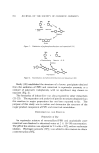
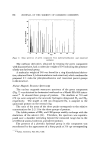
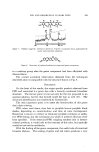
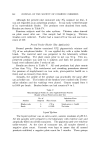
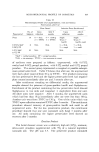
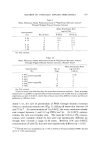
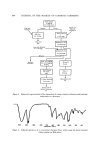
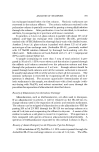
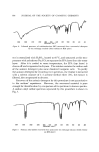
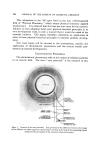
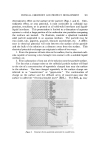
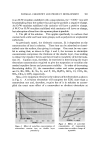
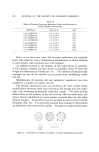
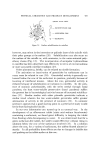
PHYSICAL CHEMISTRY AND PRODUCT DEVELOPMENT 901 electrokinetic effect on the surface of the particle (Figs. 1 and 2). Elec- trokinetic effect, or zeta potential, is most noticeable in colloidal sus- pensions, emulsions, or in general at all solid-solid interfaces and liquid- liquid interfaces. This presentation is limited to a discussion of aqueous systems in which a large portion of the molecular size particles composing the medium are ionized. To illustrate, consider a spherical insoluble solid particle suspended in an aqueous medium. The particle may be iron oxide, talc, pigment, guanine, bismuth oxychloride, etc. A differ- ence in electrical potential will exist between the surface of the particle and the bulk of the solution at a distance away from the surface. This electrical potential or charge can originate in either of two ways: 1. From the presence of ionic sites on the surface, that is, chemical radi- cals capable of ionizing when brought into contact with a suitable liquid medium or, 2. From adsorption of ions out of the solution onto the particle surface. The fact that a charge exists on the colloidal particle surface will lead to the rise of a concentration of oppositely charged ions near the surface in the solution. The ions charged oppositely to the surface charge are referred to as "counter-ions" or "gegen-ions." The combination of charge on the surface and the diffused array of counter-ions near the surface is called the "electrical double layer" (EDL). The EDL, •, may ..... :4: •.:-- ,: • '.,., ,:' ,..•,. :'.'. " -,._• Figure 2. Concept of zeta potential present• in model form

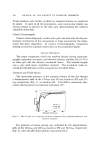
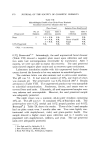
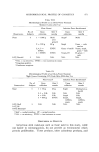
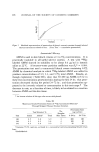
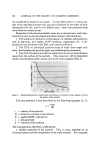
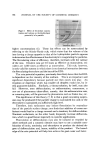
902 JOURNAL OF THE SOCIETY OF COSMETIC CHEMISTS be considered to consist of two parts' (a) the Stern layer (1) which con- sists of the adsorbed counter-ions and has a thickness in the order of ionic dimensions (few •_) and (b) the diffuse layer, where the potential drop away from the surface occurs. Properties of this electrical double layer are reviewed below and corre- lated to the day-to-day developmental observations in the laboratory. 1. The stability or resistance to flocculation of colloids, solid particles, such as pigments, iron oxides, O/W emulsions, suspensions, etc., is de- pendent on the thickness of the EDL and is determined by it. 2. The EDL on individual particles tends to make these repel each other, thus keeping the particles apart and stabilizing the suspension. 3. The electrical potential will eventually drop to zero at some distance away from the surface of the particle. This, however, will be dependent on the concentration of the counter-ions in the external phase (Fig. 3). ' •4b ..... x ....... 0 0,• 1•0 !•$ ,2•0 Z• Figure & Relationship be•een double layer potential ½ as a function of the distance X from the s•face of the particle The zeta potential is best described by the following equation (2, 3)' 4• •- DE • = velocity of the particle D = dielectric constant of the medium E = applied EMF, volts per cm • = zeta potential • = viscosity of the medium The zeta potential, therefore, is affected by' 1. Surface potential of the particle. This, in turn, depends on its chemical nature and the composition of the bulk solution. For example,
Purchased for the exclusive use of nofirst nolast (unknown)
From: SCC Media Library & Resource Center (library.scconline.org)