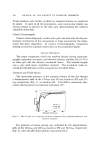
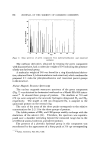
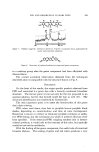
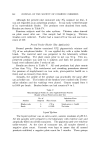
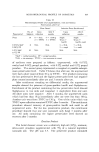
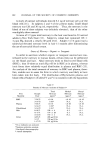
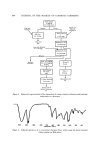
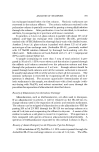
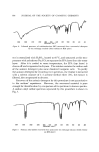
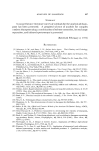
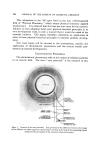
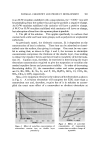
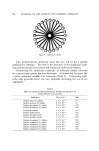
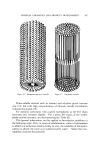
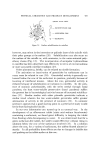
PHYSICAL CHEMISTRY AND PRODUCT DEVELOPMENT 907 Figure 10. Elongated spherical micelle Figure 17. Log boom micelle Water-soluble solvents such as ethanol and ethylene glycol increase cmc (14) but with high concentrations of ethanol, micelle formulation is almost eliminated (15). For nonionic surfactants with a given hydrophobe, as the EO chain increases, cmc increases slightly. For a given EO chain, as the hydro- phobe mol wt increases, cmc decreases sharply (Table II). This general information can be applied to formulation problems in the following ways: First, in terms of solubilization, when a hydrocarbon is added to a surfactant solution below its cmc, the solubility of the hydro- carbon is almost the same as in surfactant-free water. Above the cmc, solubility increases dramatically.

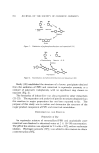
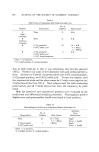
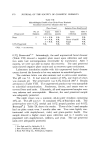
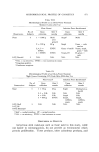
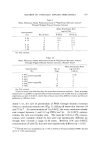
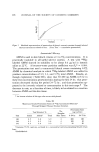
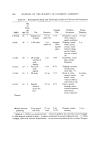
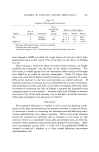
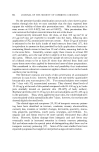
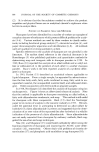
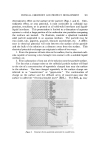
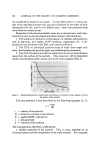
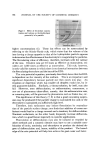
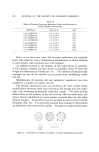
908 JOURNAL OF THE SOCIETY OF COSMETIC CHEMISTS Table II Effect of Nonionic Surfactant Molecular Weight and Structure on Critical Micelie Concentration Surfactant Cmc (m/1.) Ref. n C•= O(5EO) H 8.7 X 10-• (16) n C•= O(7EO) H 8.0 X 10 -5 (16) n C•= O(9EO) H 1.0 X 10 -4 (16) n C•2 O(12EO) H 1.4 X 10 -4 (16) n Ca O(6EO) H 9.8 X 10 -• (17) n C•00(6EO) H 9.2 X 10 -4 (18) n C•20(6EO) H 8.7 X 10 -5 (18) n C•40(6EO) H 1.0 X 10-0 (18) Since, as we have seen, cmc's for nonionic surfactants are markedly lower than those for ionics, hydrocarbon solubilization in dilute solutions is much greater with nonionics than with anionics. An additional factor is the polarity of the hydrocarbon in question. A 1 øfo nonionic solution has been shown to solubilize about 10 times the weight of n-dodecanol as n-dodecane (19). The addition of salts generally increases the size of the micelles and increases their solubilizing power (20-22). Solubilization of essential oils and perfumery ingredients has been studied by a number of workers (23-27). The general conclusions that can be drawn are that, within limits, solubilization decreases both with increasing EO groups and, less mark- edly, with increasing hydrophobe molecular weight. The most striking effects relate to the polarity of the oil involved with the more polar oils (clove, thyme) solubilized in much greater amounts than the less polar (fennel, orange). These effects may be ascribed in part to mixed micelle formation (Fig. 12). It is generally assumed that nonpolar hydrocarbons are dissolved in the center of the micelie. Semipolar or polar solubilizates, SURFACE SOLUBILIZATE ACTIVE AGENT Figure 12. Orientation of nonpolar, semipolar, and polar solubilizates in micelies
Purchased for the exclusive use of nofirst nolast (unknown)
From: SCC Media Library & Resource Center (library.scconline.org)