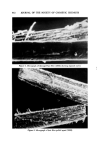
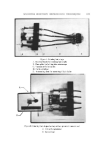
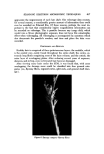
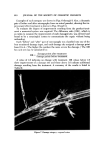
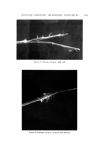
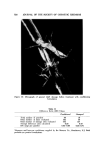
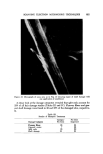
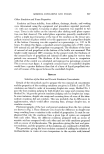
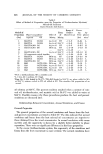
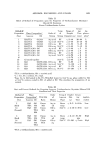
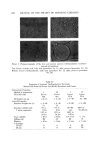
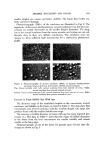
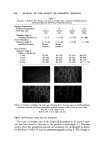
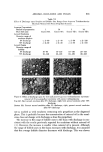
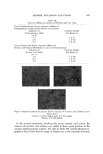
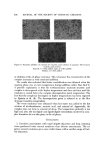
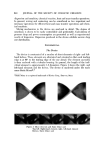
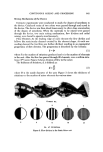
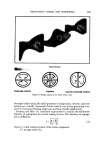
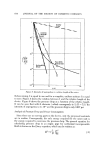
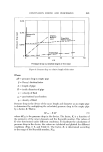
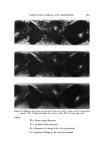
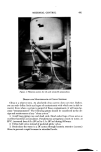
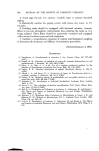
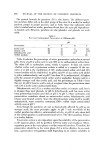
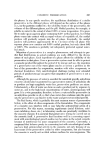
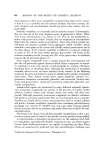
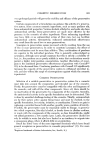
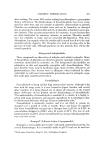
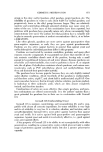
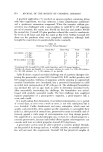
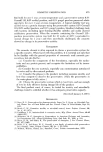
636 JOURNAL OF THE SOCIETY OF COSMETIC CHEMISTS Figure 6. Stepwise addition of mineral oil-myristic acid solution to aqueous TEA (excess myristic acid system) Top left. 1/3 MA added right, 2/3 MA added Bottom. 3/3 MA added as addition of the oil phase continues. This is because the concentration of the complex increases as with continued addition. The results also indicated that better emulsification was obtained when the aqueous phase was at room temperature during addition rather than 54.4øC. A possible explanation is that the triethanolamine myristate/myristic acid complex is decomposed at the higher temperature and does not form until the emulsion is cooled below the complex decomposition point temperature. The fact that the complexes decompose at higher temperatures has been reported by Epstein et al. (6). The decomposition point is referred to as the film drainage transition temperature. The worst emulsions were obtained when hot water was added to the hot mixture of triethanolamine, myristic acid, and mineral oil. Apparently, the complex does not form in mineral oil alone. The temperature probably is too high and, also, the ion-dipole and dipole-dipole interactions involved in com- plex formation do not take place in the oil phase. CONCLUSIONS 1. Emulsion concentrates with small droplet diameters and long creaming times produced better aerosol emulsions than inferior concentrates. The su- perior aerosol emulsions gave more stable foams with a smaller range of bub- ble diameters.

AEROSOL EMULSIONS AND FOAMS The best emulsion concentrates, therefore, gave the best aerosol foams, at least when triethano]amine myristate was the surfactant. If this relationship is true for most anionic surfactant aeroso] systems, it emphasizes the desirabi]ity of determining the best method for preparing the emulsion concentrate. 2. The preferred method for preparing the mineral oil emulsion concen- trates was to add aqueous triethanolamine at room temperature to the min- eral oil/myristic acid mixture. It is proposed that the efficiency of this pro- cedure results from the formation of the triethanolamine myristate/myristic acid complex during the initial mixing of the aqueous and oil phases. The presence of the acid soap complex enhances emulsification and emulsion sta- bility. 3. The droplets in the aerosol emulsions decrease slightly in diameter dur- ing discharge. This is due to migration of liquefied propellant to the vapor phase. The range of bubble diameters in the foam increases during discharge, but the average bubble diameter probably decreases. (Received February 2, 1973) REFERENCES (1) Sanders, P. A., The relationship between aerosol emulsions and foams. I. Triethan- olamine myristate/Freon propel]ant systems, J. Soc. Cosmet. Chem., 24, 87-101 (1973). (9.) Sanders, P. A., Complex formation in aerosol emulsions and foams. lI. Nonionic sur- factants (po]yoxyethylene fatty ethers) and polar compounds, Soap Chem. Spec., 43, Nos. 7, 8 (July, Aug. 1967). (3) Edmundson, I. C., Particle Size Analysis, in Bean, H. S., Beckerr, A. H., and Car]ess, J. E., Advances in Pharmaceutical Science, Vol. 2, Academic Press, New York, 1967. (4) Augsburger, L. L., and Shangraw, R. F., Bubble size analysis of high consistency aerosol foams and its relationship to foam theology, J. Pharm. Sci., 57, No. 4 (April 1968). (5) Sanders, P. A., Molecular complex formation in aerosol emulsions and foams, Y. Soc. Cosmet. Chem., 17, 801 (1966). •'6) Epstein, M. B., Wilson, A., Jakob, W. C. W., Conroy, L. E., and Ross, J. J., Film drainage transition temperatures and phase relations in the system sodium lauryl sul- fate, lauryl alcohol, and water, I. Phys. Chem., 58, 60 (1954).
Purchased for the exclusive use of nofirst nolast (unknown)
From: SCC Media Library & Resource Center (library.scconline.org)